Key takeaways:
Airsupra (albuterol / budesonide) is a brand-name rescue inhaler that helps prevent and treat asthma attacks in adults. It doesn’t come as a lower-cost generic.
One Airsupra inhaler costs about $603.61 without insurance, though retail prices can vary by pharmacy and location.
Most commercial and Medicaid plans cover Airsupra, but your plan may require prior authorization or step therapy. You can also lower your cost with a copay savings card, patient assistance program, or GoodRx coupon.
Save on related medications
Asthma treatment has evolved in recent years, and Airsupra (albuterol / budesonide) is one example of that progress. It’s the first rescue inhaler to pair a bronchodilator (albuterol) with an inhaled corticosteroid (budesonide) — offering both quick relief and ongoing inflammation management.
As with many new medications, Airsupra’s price depends on several factors. What you pay can vary based on your insurance coverage status, where you fill your prescription, and any discounts you use.
Here, we’ll break down what Airsupra costs without insurance and offer practical ways to pay less at the pharmacy.
How much does Airsupra cost?
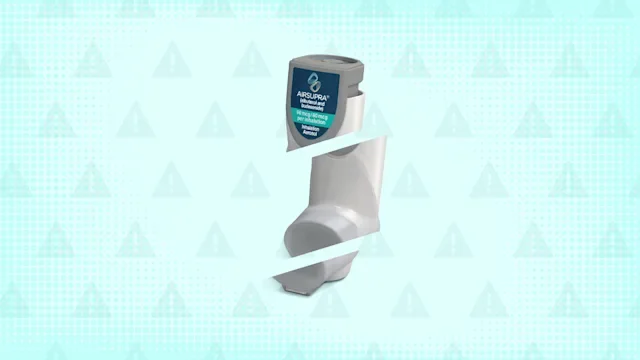
Airsupra comes as a brand-name, metered-dose inhaler. It delivers 90 mcg of albuterol and 80 mcg of budesonide per dose. Each inhaler contains 120 actuations, or puffs.
As of December 2025, the list price for one Airsupra inhaler is about $489. This amount reflects the manufacturer’s suggested price before adding any wholesaler and pharmacy markups, discounts, or insurance coverage. Actual retail prices may be higher or lower depending on the pharmacy, location, and other factors.
Here are average retail prices for Airsupra based on fill quantity:
1 inhaler (120 actuations): $603.61
2 inhalers (240 actuations): $1204.74
3 inhalers (360 actuations): $1805.87
A lower-cost generic version of Airsupra isn’t available.
What factors affect the cost of Airsupra?
What you’ll pay for Airsupra depends on several factors, including:
Insurance: If you have insurance, the cost will depend on your plan’s coverage details and cost-sharing requirements. You may need to pay out of pocket for a deductible, copays, or coinsurance.
Location: Medication prices vary by location. For instance, GoodRx research shows that people living in cities such as New York and Milwaukee often pay more for prescription medications, while those in areas such as Atlanta and Houston tend to pay lower prices.
Pharmacy: Even in the same neighborhood, prices for Airsupra can vary among pharmacies.
Dosage: How often you’ll need to administer Airsupra depends on the severity of your asthma symptoms and which other asthma medications you’re using. Most people use 2 puffs of Airsupra when asthma symptoms appear, with a maximum of 6 doses — or 12 puffs total — in a day.
Discounts: You may be able to lower the cost of Airsupra by using a copay savings card, patient assistance program, or GoodRx coupon.
Does insurance cover Airsupra?
Airsupra is covered by most commercial and Medicaid plans, as well as about half of Medicare and Affordable Care Act (ACA) marketplace plans.
Depending on your plan, you might need a prior authorization. In this case, your prescriber will have to explain to your insurer why Airsupra is medically necessary for you. Some insurers also require step therapy, which means trying other asthma inhalers first.
How different insurance plans cover Airsupra
The table below breaks down the percentage of enrollees who have coverage for Airsupra by insurance type. It also shows the likelihood of having prior authorization and step therapy requirements.
Insurance type | Enrollees covered for Airsupra | Enrollees required to get prior authorization | Enrollees required to do step therapy |
54% | 20.1% | 2.6% | |
Commercial plans (excluding ACA plans) | 90.5% | 12.6% | 11.9% |
Medicare (Medicare Advantage and Part D plans) | 54.4% | 0.4% | 3.1% |
Medicaid, including state-run and managed care plans | 99.8% | 84.7% | 12.3% |
Source: Managed Markets Insight & Technology, LLC™, as of September 11, 2025 (See methodology below.)
If your insurance doesn’t cover Airsupra, try these options:
Ask your prescriber about other asthma inhalers that may be covered by your plan or cost less out of pocket.
See if you qualify for financial assistance through Airsupra’s manufacturer copay savings card or patient assistance program.
Request a formulary exception from your insurer. Your prescriber may need to submit paperwork and a letter of medical necessity explaining why you need Airsupra.
If your insurer denies a formulary exception request, file an appeal.
During the open enrollment period for health insurance, look for a plan that offers better coverage for Airsupra and your other medications.
Ways to save on Airsupra
Airsupra costs hundreds of dollars per inhaler without insurance. But there are ways to lower your out-of-pocket inhaler costs — no matter your insurance status. Here are five ways to save on Airsupra.
1. Use a GoodRx coupon
GoodRx offers free coupons that can lower the cost of Airsupra. A quick search on GoodRx can also help you compare prices at various pharmacies to find the best Airsupra price in your area.
Using a free GoodRx coupon, Airsupra may cost as little as:
1 inhaler (120 actuations): $498.38
2 inhalers (240 actuations): $980.27
3 inhalers (360 actuations): $1462.15
To get your coupon:
Go to the GoodRx website or download the app, which is available on the Apple App Store and Google Play.
Search for “Airsupra” and click on “Find the lowest prices.”
Input your desired quantity.
Print the coupon or get it by text, email, or on your phone screen.
Show the coupon when you drop off your prescription at the pharmacy to avoid delays at checkout. Showing a coupon for the first time at the pickup window will prompt your prescription to be reprocessed.
2. See if you qualify for a copay savings card
You could pay as little as $0 for your Airsupra prescription with the Supra Savings Card. This is a manufacturer-sponsored copay savings card. To qualify, you need to:
Have commercial insurance that covers Airsupra with no restrictions
Live in the U.S. or one of its territories
Have a valid Airsupra prescription
You’re not eligible for this copay savings card if you have Medicaid, Medicare, U.S. Department of Veterans Affairs (VA) coverage, Tricare, or another form of government-funded insurance.
3. Check if you’re eligible for a patient assistance program
If you don’t qualify for the Supra Savings Card, you may still be able to get help through the manufacturer’s AZ&Me patient assistance program. If approved, you’ll receive Airsupra at no cost.
You can apply for this opportunity online. To be eligible, you should:
Be uninsured or have Medicare (but not be eligible for or enrolled in Medicare Extra Help)
Not receive any other payment assistance for Airsupra
Meet certain income requirements
Live in the U.S. or one of its territories
Be treated by a healthcare professional licensed in the U.S.
Have a valid Airsupra prescription
You may also qualify for this program if you’ve had a major life change in the past year, such as a job or income change, loss of drug coverage, or marital status change.
4. Ask about filling multiple inhalers at once
Sometimes, filling a larger quantity of a medication at once can cost less per dosage than making several smaller refills. For Airsupra, that could mean getting up to three inhalers at a time, depending on how often you use it. This can be more convenient and may lower your overall cost.
Some insurance plans also offer additional savings when you use their preferred mail-order pharmacy.
5. Tap into your HSA, FSA, or HRA
If you have a health savings account (HSA), flexible spending account (FSA), or health reimbursement arrangement (HRA), you can use those tax-free dollars to cover the cost of Airsupra.
FSA funds are only valid for a limited time, though. You should use any FSA funds you have by the end of the plan year before they expire. HSA funds, by comparison, roll over annually and can be used at any time.
The bottom line
Airsupra (albuterol / budesonide) is a prescription rescue inhaler that helps prevent and treat asthma attacks in adults. Airsupra’s average retail cost without insurance is about $603.61 for one inhaler.
While Airsupra can be costly without insurance, most commercial and Medicaid plans cover it. The Supra Savings Card, AZ&Me patient assistance program, and GoodRx coupons can also help lower your out-of-pocket expenses. Checking pharmacy prices and filling an order for multiple inhalers at once may help you save, too.

Why trust our experts?



Methodology
We obtained national prescription coverage data for each medication from Managed Markets Insight & Technology (MMIT). The data reflects health insurance coverage as of September 2025.
We calculated the percentage of enrollees in plans that cover each medication by dividing the number of enrollees covered for the medication within a specific insurance channel (e.g., ACA, Medicare, Medicaid) by the total number of enrollees in all plans within that channel.
We determined the percentage of enrollees in plans with a prior authorization requirement by calculating the proportion of enrollees in plans that required prior authorization for the medication within each channel.
Finally, we measured the percentage of enrollees in plans with a step therapy requirement by calculating the proportion of enrollees in plans that imposed step therapy requirements for the medication in each channel.
These estimates, derived from national MMIT coverage data, provide insight into health insurance coverage for each medication. They take into account restrictions such as prior authorization, step therapy, and quantity limits. The percentages are expressed relative to the total number of enrollees covered by various insurance channels, including ACA plans, commercial (excluding ACA) plans, Medicare, and Medicaid (both state-run and managed care plans).
References
Airsupra. (n.d.). Cost assistance with Airsupra. AstraZeneca.
AstraZeneca. (2024). Airsupra (albuterol/budesonide) now available as the first and only FDA-approved anti-inflammatory rescue option for asthma. Business Wire.
AstraZeneca Pharmaceuticals. (2025). Airsupra- albuterol sulfate and budesonide aerosol, metered [package insert].
AZ&Me. (n.d.). Medications that are included in the AZ&Me program. AstraZeneca.
HealthCare.gov. (n.d.). Appealing a health plan decision.
Medicaid.gov. (n.d.). Managed care.