Syfovre
Syfovre (pegcetacoplan) is a medication used to treat a severe eye problem called geographic atrophy (GA) from age-related macular degeneration (AMD). It's important to treat this condition because it can lead to permanent vision loss. Syfovre (pegcetacoplan) is given as an injection directly into the back of your eye by a healthcare provider.


What is Syfovre (pegcetacoplan)?
What is Syfovre (pegcetacoplan) used for?
- Geographic atrophy due to age-related macular degeneration
How Syfovre (pegcetacoplan) works
Syfovre (pegcetacoplan) is a complement inhibitor. It works by attaching to certain proteins in your immune system called complement proteins. By attaching to these proteins, Syfovre (pegcetacoplan) prevents your immune system from causing inflammation and damage to the retina in your eyes. This helps to prevent worsening of age-related macular degeneration.
Drug facts
| Common Brands | Syfovre |
|---|---|
| Drug Class | Complement inhibitor |
| Controlled Substance Classification | Not a controlled medication |
| Generic Status | No lower-cost generic available |
| Availability | Prescription only |

Side effects of Syfovre (pegcetacoplan)
The following side effects may get better over time as your body gets used to the medication. Let your healthcare provider know immediately if you continue to experience these symptoms or if they worsen over time.
Common Side Effects
- Eye discomfort (10-13%)
- Wet AMD (7-12%)
- Seeing "floaters" (7-10%)
- Bright red patch in the white of the eye (eye bleed; 8%)
- Vitreous detachment (4-6%)
Less Common Side Effects
- Punctate keratitis (clumps of cells on eye surface leading to red, watery, light-sensitive eyes)
- Posterior capsule opacification (leading to blurry vision)
- Eye pain and swelling
- Higher pressure in the eye
The following Syfovre (pegcetacoplan) side effects have also been reported
Side effects that you should report to your care team as soon as possible:
- Allergic reactions—skin rash, itching, hives, swelling of the face, lips, tongue, or throat
- Blurry vision, vision loss, seeing wavy or bent objects or blind spots with dark, light, or flashing spots
- Eye pain, redness, irritation, or discharge with blurry or decreased vision
- Sensitivity to light
Side effects that usually do not require medical attention (report these to your care team if they continue or are bothersome):
- Eye irritation or itching
- Small spots floating in vision

Pros and cons of Syfovre (pegcetacoplan)
Pros
- First and only treatment approved for GA
- Slows the rate of worsening vision
- Flexible dosing schedule; given every 25 to 60 days
Cons
- Must be given as an injection directly into the back of the eye, which might be uncomfortable
- Needs to be given by a trained healthcare provider
- Doesn't cure AMD

Pharmacist tips for Syfovre (pegcetacoplan)

- Make sure to mark your appointments on your calendar to see your provider to receive your Syfovre (pegcetacoplan) doses. This helps make sure you're properly monitored and that you don't miss any of your doses.
- Syfovre (pegcetacoplan) is only given at a clinic. It has to be injected into the eye by a healthcare provider with the proper supplies and technique.
- Before your injection, you can expect to get some numbing medication to help with pain and antibiotics to prevent infection.
- If you experience severe eye pain, redness, or worsening vision after receiving Syfovre (pegcetacoplan), contact your provider right away. You'll likely need to be examined for new or worsening eye problems.

Risks and warnings for Syfovre (pegcetacoplan)
Syfovre (pegcetacoplan) can cause some serious health issues. This risk may be even higher for certain groups. If this worries you, talk to your doctor or pharmacist about other options.
Eye infection and retinal damage
Eye injections, like with Syfovre (pegcetacoplan), can lead to infection of the fluid inside the eyeball (a condition called endophthalmitis) or retinal detachment. These complications can cause poor vision or blindness. If you experience severe eye pain, redness, or worse vision after your injection, contact your provider right away.
Wet age-related macular degeneration (AMD)
- Risk factors: Receiving Syfovre (pegcetacoplan) once per month
Syfovre (pegcetacoplan) can cause wet AMD. In clinical studies lasting 2 years, 12% of people receiving Syfovre (pegcetacoplan) once per month had developed wet AMD, while 7% of people receiving Syfovre (pegcetacoplan) every other month developed this complication. Your provider will check your eyes for wet AMD and give you treatment if needed.
High eye pressure
Syfovre (pegcetacoplan) can cause high eye pressure within minutes of the injection. Your provider will check your eye pressure on a regular basis to make sure it doesn't go too high.

Syfovre (pegcetacoplan) dosage
Typical dosage for Syfovre (pegcetacoplan)
The typical dose is 15 mg injected directly into the affected eye(s) by a trained healthcare provider once every 25 to 60 days.

Syfovre (pegcetacoplan) contraindications
Contraindications are specific health conditions or situations in which a person should not take a medication due to safety concerns. If you have any of the following conditions or if any of the following apply to you, let your healthcare provider know because Syfovre (pegcetacoplan) will not be safe for you to take.
- Active infection in or around the eye
- Active eye inflammation

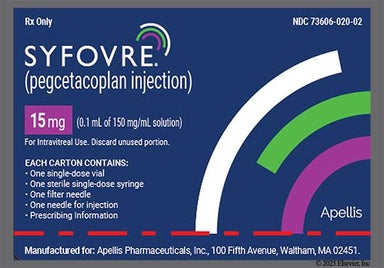
Syfovre (pegcetacoplan) images