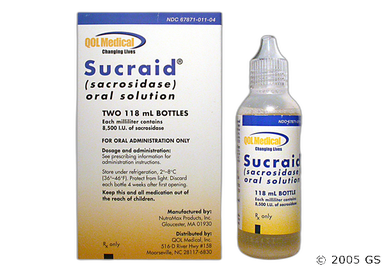
Sucraid
Sucraid (sacrosidase) is an oral solution used to treat a rare genetic condition called congenital sucrase-isomaltase deficiency (CSID). It works as an enzyme supplement to help break down sucrose (table sugar), a common sugar found in food. Sucraid (sacrosidase) can be used in adults and children 5 months and older. It must be mixed with cold or room temperature liquids (e.g., water, milk, or baby formula) and taken every time you eat a meal or snack. Common side effects include stomach pain, vomiting, and nausea.


What is Sucraid (sacrosidase)?
What is Sucraid (sacrosidase) used for?
- Replaces sucrase in people (5 months and older) with congenital sucrase-isomaltase deficiency (CSID)
How Sucraid (sacrosidase) works
Sucraid (sacrosidase) is an enzyme replacement therapy that helps break down sucrose (table sugar), a common sugar in food. It replaces sucrase, a digestive enzyme that people with CSID don’t have enough of. Without sucrase, sugars can build up in the gut, causing diarrhea, gas, bloating, and stomach pain. By providing the missing enzyme, Sucraid (sacrosidase) helps digest sucrose and relieves CSID symptoms.
Drug facts
| Common Brands | Sucraid |
|---|---|
| Drug Class | Enzyme replacement therapy |
| Controlled Substance Classification | Not a controlled medication |
| Generic Status | No lower-cost generic available |
| Availability | Prescription only |

Side effects of Sucraid (sacrosidase)
The following side effects may get better over time as your body gets used to the medication. Let your healthcare provider know immediately if you continue to experience these symptoms or if they worsen over time.
Common Side Effects
- Stomach pain (4%)
- Vomiting (3%)
- Nausea (2%)
- Diarrhea (2%)
- Constipation (2%)
Less Common Side Effects
- Trouble sleeping
- Headache
- Nervousness
- Dehydration
Sucraid (sacrosidase) serious side effects
Contact your healthcare provider immediately if you experience any of the following.
- Serious allergic reaction: rash, wheezing, itchiness, trouble breathing, swelling of the face

Pros and cons of Sucraid (sacrosidase)
Pros
- The only FDA-approved oral medication for CSID
- Generally well tolerated by most people
- Safe to take for children 5 months and up
Cons
- Can only be mixed with cold or room temperature water, milk, or baby formula
- Must be taken with each meal or snack
- Is only available from a specialty pharmacy

Pharmacist tips for Sucraid (sacrosidase)

- Sucraid (sacrosidase) solution comes with a scoop and a dropper. One full scoop or 28 drops from the dropper equals 1 ml. Make sure to rinse the scoop or dropper with water after each use.
- Sucraid (sacrosidase) is available in both a multiple-use and single-use bottles. Your healthcare team will help you decide which option is best for you.
- Mix Sucraid (sacrosidase) with water, milk, or baby formula. Don't take it with fruit juices like apple or orange juice since their acidity can affect how well the medication works.
- Sucraid (sacrosidase) should only be mixed with cold or room temperature liquids. Never heat up this medication since it’s sensitive to high temperatures and might not work as well.
- For best results, take half of your Sucraid (sacrosidase) dose before eating and the other half during the meal or snack. This helps break down sugars while you eat and can reduce digestive symptoms.
- Throw away any unused multi-use Sucraid (sacrosidase) 4 weeks after it's been opened as the medication contains no preservatives. Write the date you first opened the bottle on the label.
- Store Sucraid (sacrosidase) in the refrigerator. If you mix a dose with liquid but don’t use it right away, throw it away after 24 hours.
- Each single-dose Sucraid (sacrosidase) bottle contains 2 mL. Mix the entire bottle with 120 mL of liquid. If you only use half of the mixture, store the other half in the refrigerator for up to 24 hours.

Risks and warnings for Sucraid (sacrosidase)
Sucraid (sacrosidase) can cause some serious health issues. This risk may be even higher for certain groups. If this worries you, talk to your doctor or pharmacist about other options.
Serious allergic reaction
- Risk factors: Allergic to yeast, glycerin, or papain
Sucraid (sacrosidase) can cause allergic reactions, which can be life-threatening. Your risk is higher if you're allergic to yeast, glycerin (a sugar alcohol found in some cough medications and moisturizers), or papain (a protein found in unripe papaya). Get medical help right away if you have symptoms of allergic reactions, such as hives, shortness of breath, and swelling of your face, lips, or throat.
High blood sugar
- Risk factors: People with diabetes
Sucraid (sacrosidase) works by breaking down sucrose into glucose and fructose, smaller sugar components that your body absorbs. This can raise blood sugar levels, especially if you have diabetes. Your prescriber might check your blood sugar and adjust your diet if needed to help keep it in a healthy range.
Low starch diet
Sucraid (sacrosidase) doesn’t replace isomaltase, an enzyme that helps break down starch. This means you might still have CSID symptoms even after taking the medication. If your symptoms don’t improve, you might need to limit starchy foods like bread, bananas, and potatoes. Talk to your prescriber about adjusting your diet if needed.

Sucraid (sacrosidase) dosage
Typical dosage for Sucraid (sacrosidase)
- People weighing 15 kg (33 lbs) and under: The typical dose is 1 ml (8,500 IU) mixed with 2 ounces (60 ml) of water, milk, or baby formula. Take by mouth with each meal and snack.
- People weighing more than 15 kg (33 lbs): The typical dose is 2 ml (17,000 IU) mixed with 4 ounces (120 ml) of water, milk, or baby formula. Take by mouth with each meal and snack.

Sucraid (sacrosidase) contraindications
Contraindications are specific health conditions or situations in which a person should not take a medication due to safety concerns. If you have any of the following conditions or if any of the following apply to you, let your healthcare provider know because Sucraid (sacrosidase) will not be safe for you to take.
- Allergic to yeast, yeast products, glycerin, or papain (protein found in papaya fruit)



