


Should People Without Diabetes Use a Continuous Glucose Monitor? What 4 Doctors Say
The FDA approved the first OTC continuous glucose monitor (CGM). Learn about CGMs for those without diabetes and how to get one without diabetes.
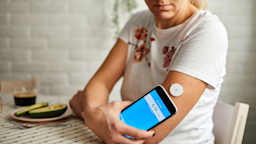
Stelo Glucose Biosensor System is the first over-the-counter continuous glucose monitoring (CGM) system for adults. The system uses a sensor that's attached to your skin to keep track of your glucose levels. The sensor can be scanned and read using an app on a smart device, such as a smartphone. You can use Stelo whether or not you have Type 2 diabetes. But this CGM isn't meant for people with problematic hypoglycemia nor for those who use insulin because it can't alert you if you have dangerously low glucose levels. Some side effects of this CGM include skin irritation or pain at or near the sensor site. __Stelo is expected to be available summer of 2024.

The Dexcom Stelo Glucose Biosensor System is made up of two parts that work together to measure and record your glucose levels throughout the day:
| Common Brands | Stelo |
|---|---|
| Drug Class | Continuous glucose monitoring |
| Controlled Substance Classification | Not a controlled medication |
| Generic Status | No lower-cost generic available |
| Availability | Over-the-counter |




Prescription savings
Stop paying too much for your prescriptions. Compare prices, get pharmacy coupons, and save up to 80%. Find expert answers to your health questions so you can make the best decisions for yourself and your family.
Health conditions
Medications & treatment
Access & affordability
 Our monthly healthcare membership can help you save thousands on your prescription costs.
Resources

Each Stelo sensor can be worn for up to 15 days. In some cases, the sensor might last less than 15 days and will need to be replaced sooner.
The Stelo sensor should be placed on the back of the upper arm.
Stelo displays glucose measurements every 15 minutes in the app. Keep in mind that these measurements should never be used to make medical actions without talking to a healthcare professional first.
In clinical studies, some side effects that people using Stelo reported were infection, irritation, and pain at or near the site of the sensor.
No. Stelo is over-the-counter (OTC), and you don't need a prescription to buy it.
According to the manufacturer, Stelo will be available during the summer of 2024.
Both Stelo and Dexcom G7 are continuous glucose monitoring systems (CGMs), but they have a few differences. For one, Stelo is available OTC, while Dexcom G7 requires a prescription from a healthcare professional. Another difference is that Stelo is for adults only. But Dexcom G7 is approved for adults and children ages 2 years and older. Lastly, Stelo can't alert you if you have dangerously low glucose levels, so it isn't meant for people using insulin or who've problematic hypoglycemia. But Dexcom G7 can send alerts if your glucose level is out of range. Talk with a healthcare professional about the best CGM option for you.
