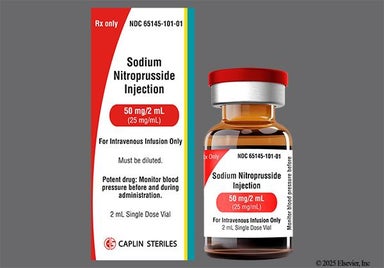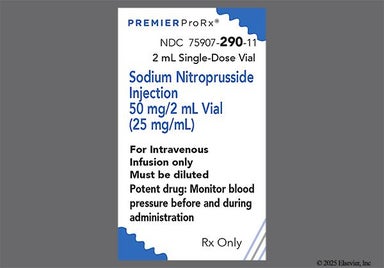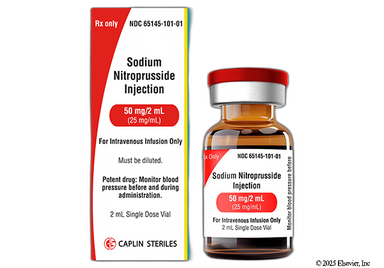
Sodium nitroprusside (Nipride RTU) is a medication used in the hospital to treat medical emergencies related to extremely high blood pressure. It can also help with certain heart or bleeding problems. This medication is given as a continuous infusion through the veins. Your provider will need to closely monitor your blood pressure and heart rate while you receive sodium nitroprusside (Nipride RTU).
Sodium nitroprusside (Nipride RTU) is used for people in the hospital to 1) quickly lower blood pressure during a hypertensive crisis (severely high blood pressure); 2) control blood pressure to lower the amount of bleeding during surgery; and 3) treat short-term, symptomatic heart failure.
Sodium nitroprusside (Nipride RTU) is a vasodilator. It works by producing a chemical called nitric oxide (NO) in your blood. Nitric oxide causes your blood vessels to relax and dilate (open up). This allows your blood to flow more easily throughout your body and lowers your blood pressure.
Sodium nitroprusside (Nipride RTU) is given as an injection through the veins (intravenously, IV) that's infused continuously. The dose of sodium nitroprusside (Nipride RTU) is different from one person to another, because it depends on why you need it, your weight, and how you respond to the medication. Your provider will closely monitor you to adjust your dose based on how your blood pressure responds to the medication. Hospitals typically require people to be in a high level-of-care unit (e.g., intensive care unit, ICU) to receive sodium nitroprusside (Nipride RTU). This is because certain machines are needed to continuously monitor your blood pressure to make sure the medication is as safe for you as possible.
Possible side effects include low blood pressure (e.g., lightheadedness, dizziness), changes in heart rate, flushing (feeling warm all of a sudden), and rash.
Though rare, there's a risk for cyanide poisoning when sodium nitroprusside (Nipride RTU) is used at higher doses or used for a long time. This is because sodium nitroprusside (Nipride RTU) is broken down in your body into a chemical called cyanide. Cyanide can be toxic if your levels become too high when your body produces the chemical faster than its ability to remove it. To lower your risk for cyanide poisoning, your provider will monitor how much sodium nitroprusside (Nipride RTU) you get. They might also give you sodium thiosulfate while you're receiving sodium nitroprusside (Nipride RTU) to help get rid of cyanide. Symptoms of cyanide poisoning can include dizziness, headache, nausea, vomiting, rapid breathing, fast heart rate, and seizures. If you're diagnosed with cyanide poisoning, your provider will give you appropriate treatment with sodium thiosulfate and Cyanokit (hydroxocobalamin).