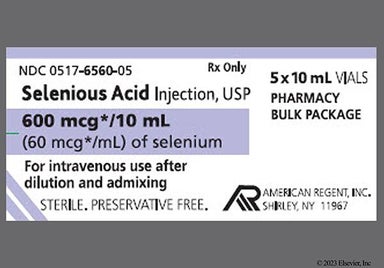
Selenious acid is a selenium supplement used to treat low selenium levels. It's added to total parenteral nutrition (TPN) and infused through the veins. It can be given to both children and adults, but it might not be safe for people with kidney problems.
Prescription savings
Stop paying too much for your prescriptions. Compare prices, get pharmacy coupons, and save up to 80%.Health conditions
Medications & treatment
Access & affordability
Resources
Selenious Acid is an injectable nutritional supplement that's typically used along with total parenteral nutrition (TPN). It provides selenium for people who can't eat or drink by mouth. Giving selenium, an essential nutrient in our diet, can help with symptoms of muscle pain and tenderness that occur when the levels are too low.
Selenious Acid is typically added to TPN solutions and injected through a vein to provide nutrients for people can't take in nutrients or fluids by mouth. Your dose of Selenious Acid will be determined by your provider based on your age, body weight, and condition.
You're not likely to experience side effects with Selenious Acid at the dosages recommended by your provider. But since Selenious Acid is given as a part of TPN, you might experience side effects from other ingredients of TPN. For example, sometimes TPN mixtures can form tiny crystals or solids. This might cause problems, like clots in your lungs. Your providers will check your TPN bag for any solids before your infusion to minimize your risk. But if you have trouble breathing or feel pain, let your provider know immediately because these might be signs of clots.
Selenious Acid contains aluminum, which can build up and cause harm for people with kidney problems or for premature babies whose kidneys aren't yet fully developed. High levels of aluminum can be toxic to your brain, nerves and bones. Let your provider know if you have kidney problems before starting TPN solutions with Selenious Acid.
Selenious Acid given with TPN solutions at the recommended dose isn't expected to cause harm during pregnancy or breastfeeding. But not having enough selenium in your body can cause harm to your unborn baby. Let your provider know if you have questions about the risk and benefit of using Selenious Acid during pregnancy or breastfeeding.