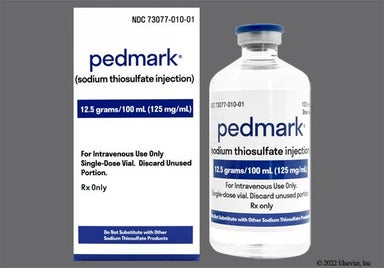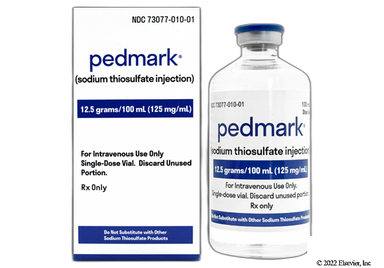
Pedmark (sodium thiosulfate) is the first and currently only FDA-approved therapy used to prevent hearing damage from cisplatin treatments that last 1-6 hours. It's used in children older than 1 month old. Pedmark (sodium thiosulfate) is infused into the veins by a healthcare provider.
Pedmark (sodium thiosulfate) is a cytoprotective agent (medication that protects your cells). It's used in children older than 1 month who are receiving anticancer treatment with cisplatin. Specifically, Pedmark (sodium thiosulfate) is used to protect your child from hearing loss, which is a side effect of cisplatin. Cisplatin can cause loss of hearing because it damages the hair cells in the ear that help your child hear. Pedmark (sodium thiosulfate) helps to lower the risk of hearing loss by counteracting the toxic effects of cisplatin on your child's normal hair cells in the ear.
Pedmark (sodium thiosulfate) is typically infused into the veins over 15 minutes by a healthcare provider. It's usually given to your child 6 hours after their last cisplatin infusion and 10 hours before the next one. The dose of Pedmark (sodium thiosulfate) depends on body surface area (BSA), which takes into account your child's weight and height. Your child's provider will calculate the right dose for them.
Nausea and vomiting are common side effects of Pedmark (sodium thiosulfate). Before your child receives their infusion, their provider will give them medications to help prevent nausea as an extra precaution.
Pedmark (sodium thiosulfate) can cause serious allergic reactions. Let your child's provider know if your child is allergic to foods or medications with sulphite additives, such as dried fruits. During the infusion, your child's provider will watch for any signs and symptoms of a reaction, such as rash, hives, trouble breathing, and swelling of the lips, tongue, throat, or face. This is to make sure Pedmark (sodium thiosulfate) is safe for your child. If your child has a reaction, their provider will stop the infusion. They'll give your child some medications to help prevent an allergic response to Pedmark (sodium thiosulfate) before future infusions.
Pedmark (sodium thiosulfate) can sometimes lead to high sodium levels and low potassium levels in the body. High sodium levels can cause thirst, muscle weakness or spasms, restlessness, and poor appetite. Low potassium levels can affect heart rhythm, causing the heart to beat irregularly. Before receiving Pedmark (sodium thiosulfate), your child's provider will need to check your child's blood work to make sure this medication is safe for them. They will also watch for symptoms that include changes in heart beat, tiredness, high blood pressure, or muscle spasms during the infusion in case they need to stop the medication temporarily.
Pedmark (sodium thiosulfate) and generic sodium thiosulfate aren't the same. The two medications aren't interchangeable. Pedmark (sodium thiosulfate) has a unique formulation of sodium thiosulfate that's used to lower the risk of hearing problems in children receiving cisplatin. On the other hand, generic sodium thiosulfate injection is used as an antidote with sodium nitrite to stop cyanide poisoning. If you've questions on the differences between Pedmark (sodium thiosulfate) and generic sodium thiosulfate, talk to your child's provider.