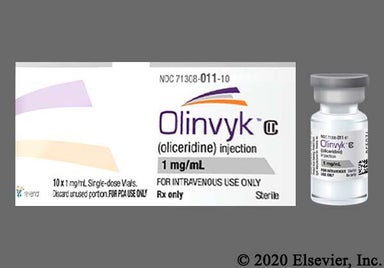
Olinvyk
Olinvyk (oliceridine) is a opioid pain medication approved by the FDA in 2020. It's a short-term pain treatment, typically only used in the hospital to treat severe pain that can't be controlled by other pain medications. Olinvyk (oliceridine) is given IV, usually through a special medication pump that's programmed by your provider to deliver the right dose to you when you press a button.


What is Olinvyk (oliceridine)?
What is Olinvyk (oliceridine) used for?
- Treatment of severe pain when non-opioid medications or oral opioid medications haven't worked well
Drug facts
| Common Brands | Olinvyk |
|---|---|
| Drug Class | Opioid |
| Controlled Substance Classification | Schedule II |
| Generic Status | No lower-cost generic available |
| Availability | Prescription only |

Risks and warnings for Olinvyk (oliceridine)
Olinvyk (oliceridine) can cause some serious health issues. This risk may be even higher for certain groups. If this worries you, talk to your doctor or pharmacist about other options.
Potentially life-threatening slowed breathing (respiratory depression)
- Risk factors: Taking medications that can cause slow breathing (benzodiazepines, opioids, sedatives) | Drinking alcohol | Medical conditions that cause breathing problems (e.g., COPD, asthma) | People age 65 years and older | Low body weight | Debilitated people
 Olinvyk (oliceridine) can cause life-threatening irregular or slowed breathing. Respiratory depression can happen at any time, even at recommended doses. This can cause you to stop breathing and can even lead to death, so it's important to recognize signs of breathing problems and treat them right away. Your provider will have naloxone (Narcan) on hand in case you experience respiratory depression and need to reverse the effects of Olinvyk (oliceridine). If you get shortness of breath, slow or shallow breathing, or bluish-colored lips, fingers, or toes, naloxone (Narcan) will be given to you.
Opioid withdrawal syndrome in newborns
- Risk factors: Taking Olinvyk (oliceridine) during pregnancy
Let your provider know if you're pregnant before you receive Olinvyk (oliceridine). This medication can be passed to your unborn baby if you take it during pregnancy. Once your baby is born, they might experience withdrawal symptoms which include high-pitched crying, poor feeding and sucking behavior, trembling, irritability, abnormal sleep patterns, and seizures. Withdrawal symptoms is more typically seen in babies born to mothers who used opioids for a long time during pregnancy, so they're not as likely to occur with Olinvyk (oliceridine).
Life-threatening abnormal heart rhythm (QT prolongation)
- Risk factors: Heartbeat or heart rhythm problems | Taking medications that affect your heartbeat or heart rhythm | Electrolytes (body salts) not in balance | Taking Olinvyk (oliceridine) at doses higher than 27 mg per day
Olinvyk (oliceridine) has been shown to delay when your heart squeezes (contracts) and then relaxes. This condition is known as QT prolongation and can raise the risk for life-threatening abnormal heart rhythms. Your risk for these problems is higher if you already have heart problems or are taking other medications that cause QT prolongation that can change your heartbeat and heart rhythm, such as amiodarone (Pacerone), beta-blockers, and moxifloxacin (Avelox). Make sure to tell your provider about all the medications you're taking before starting Olinvyk (oliceridine). If you feel symptoms of heart problems, such as pounding chest, trouble breathing, feeling faint or lightheaded, or chest pain while taking Olinvyk (oliceridine), call 911 right away.
Drug interactions
Olinvyk (oliceridine) interacts with a lot of commonly used medications. Some medications, including Olinvyk (oliceridine), will need to have the dosage adjusted. Additionally, some medications, such as benzodiazepines, opioids, and sedatives, raise your risk for severe side effects, including death. Make sure to tell your provider about all the medications you're taking before starting Olinvyk (oliceridine).
Severely low blood pressure
- Risk factors: Low blood volume | Taking Olinvyk (oliceridine) with medications that are nervous system depressants (e.g., certain antipsychotics or general anesthesia)
Olinvyk (oliceridine) can cause severely low blood pressure. Your blood pressure will likely be monitored while you're using Olinvyk (oliceridine). Let your provider know if you feel lightheaded, dizzy, fatigue, or feeling like you're going to faint.
High pressure in the brain
- Risk factors: History of high pressure in the brain | Brain tumors | Head injuries
Olinvyk (oliceridine) can raise the pressure in your brain as a result of lowering your breathing rate. Your breathing rate and level of consciousness will be monitored.
Risk in people with stomach problems
Olinvyk (oliceridine) can cause problems with your stomach. Specifically, it can cause a spasm in one of your muscular valves and raise your risk for inflammation of the pancreas.
Seizures
- Risk factors: History of seizures
Olinvyk (oliceridine) can raise the risk for seizures in people with a history of seizures or medical conditions that cause seizures.

Olinvyk (oliceridine) dosage
Typical dosage for Olinvyk (oliceridine)

Olinvyk (oliceridine) images