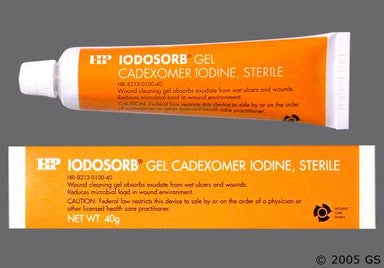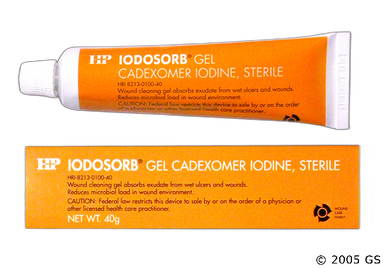
Iodosorb
Iodosorb (cadexomer iodine) is a gel that's applied to the skin to treat wet ulcers and wounds. This medication can kill bacteria, absorb exudate (pus), and clean out your wound so it can heal faster. Iodosorb (cadexomer iodine) doesn't need a prescription from your provider, and can be bought over the counter.


What is Iodosorb (cadexomer iodine)?
What is Iodosorb (cadexomer iodine) used for?
- Skin wounds or ulcers
How Iodosorb (cadexomer iodine) works
Iodosorb (cadexomer iodine) is an antimicrobial gel that can be used to treat skin wounds and ulcers. It contains tiny beads that can absorb fluids, exudate (pus), slough (dead skin), and debris (waste or dead tissues). As the beads absorb this fluid and waste, they trigger the release of iodine, which works to kill bacteria and clean your wound.
Drug facts
| Common Brands | Iodosorb |
|---|---|
| Drug Class | Anti-infective |
| Controlled Substance Classification | Not a controlled medication |
| Generic Status | No lower-cost generic available |
| Availability | Over-the-counter |

Side effects of Iodosorb (cadexomer iodine)
The following side effects may get better over time as your body gets used to the medication. Let your healthcare provider know immediately if you continue to experience these symptoms or if they worsen over time.
Common Side Effects
- Warm and tingling sensation at the site
Less Common Side Effects
- Itchiness
- Rash

Pros and cons of Iodosorb (cadexomer iodine)
Pros
- Promotes wound healing
- Color change on the gel (white) can make it easier to know when it's time to change out the medication
- Can kill bacteria on the wound
- Available over the counter
Cons
- Not for people who are sensitive to iodine
- Might not be safe for people with thyroid problems
- Not recommended for use during pregnancy or breastfeeding
- Brand only, so might be expensive

Pharmacist tips for Iodosorb (cadexomer iodine)

- Speak to your provider before using Iodosorb (cadexomer iodine) if you have any thyroid or kidney problems to determine if this medication is safe for you.
- The Iodosorb (cadexomer iodine) gel will change color from dark brown to white as the iodine is used up from absorbing the pus. This will let you know that it's time to change your dressing and apply a new layer of medication.
- Iodosorb (cadexomer iodine) shouldn't stick to your wound, but your dressing can stick if your wound is drying out or a crust forms over the area. If your dressing is sticking to your wound, wet the area with water and gently take off the dressing.
- If there are small pieces of Iodosorb (cadexomer iodine) left in your wound after removing your dressing, don't worry. This isn't harmful and it'll naturally break down over time.

Risks and warnings for Iodosorb (cadexomer iodine)
Iodosorb (cadexomer iodine) can cause some serious health issues. This risk may be even higher for certain groups. If this worries you, talk to your doctor or pharmacist about other options.
Iodine sensitivity
People who are sensitive or might be sensitive to iodine shouldn't use Iodosorb (cadexomer iodine). Speak to your provider for a different medication to treat your wound that doesn't contain iodine.
Thyroid problems
Iodine is important for your thyroid to function properly. Since Iodosorb (cadexomer iodine) contains iodine, it can affect your thyroid hormones. If you have a thyroid condition (e.g., Hashimoto's thyroiditis, Grave's disease, or non-toxic nodular goiter), it's not recommended to use Iodosorb (cadexomer iodine). Speak to your provider if you have any problems with your thyroid before using this medication to make sure it's safe for you.
Harm to babies
Iodine, a main ingredient in Iodosorb (cadexomer iodine), can cause harm to your unborn baby if you use it during pregnancy. This medication can also pass into your breast milk and harm your baby. Don't use Iodosorb (cadexomer iodine) if you're pregnant or breastfeeding, and speak to your provider for a safer alternative.

Iodosorb (cadexomer iodine) dosage
Typical dosage for Iodosorb (cadexomer iodine)
How often you use Iodosorb (cadexomer iodine) will depend on the size of your wound and when the gel changes color.
Apply the gel onto a gauze and apply light pressure to fix it onto your wound or ulcer. Maximum usage is 50 g of gel per application, and 150 g per week.

Iodosorb (cadexomer iodine) contraindications
Contraindications are specific health conditions or situations in which a person should not take a medication due to safety concerns. If you have any of the following conditions or if any of the following apply to you, let your healthcare provider know because Iodosorb (cadexomer iodine) will not be safe for you to take.
- Hashimoto's thyroiditis (immune system problem that causes inflammation of the thyroid)
- Non-toxic nodular goiter (large thyroid gland)
- Grave's disease
- Pregnant or breastfeeding

Iodosorb (cadexomer iodine) images