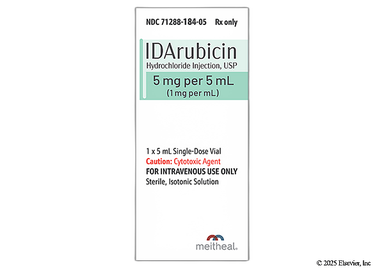
Idarubicin
IDARUBICIN treats leukemia. It works by slowing down the growth of cancer cells.
What is Idarubicin?
Overview
Idarubicin injection is used in combination with other medicines to treat acute myeloid leukemia (AML).
Idarubicin belongs to the group of medicines known as antineoplastics (cancer medicines). It works by interfering with the growth of cancer cells, which are eventually destroyed.
Idarubicin is to be given only by or under the direct supervision of your doctor.
Commonly Used Brand Name(s)
Idamycin PFS
Therapeutic Classifications
Antineoplastic Agent
Chemical Classifications
Idarubicin
Blackbox Warning
Intravenous route (Solution)
Administer slowly into a freely flowing intravenous infusion. If extravasation occurs during administration, severe local tissue necrosis will occur; never administer via IM or subQ routes. Administer only under the supervision of a physician who is experienced in leukemia chemotherapy and in facilities that can monitor for drug tolerance and toxicity. The physician and institution must be able to respond to severe hemorrhagic conditions or overwhelming infection. Like other anthracyclines, idarubicin hydrochloride injection can cause myocardial toxicity leading to congestive heart failure. Cardiac toxicity is more common in patients who have received prior anthracyclines or who have preexisting cardiac disease. Severe myelosuppression will occur with idarubicin hydrochloride when used at therapeutic doses and dose reductions are required for patients with impaired hepatic or renal function.
Proper Use
Medicines used to treat cancer are very strong and can have many side effects. Before receiving this medicine, make sure you understand all the risks and benefits. It is important for you to work closely with your doctor during your treatment.
A nurse or other trained health professional will give you this medicine in a hospital or cancer treatment center. This medicine is given through a needle placed in one of your veins. The medicine must be injected slowly, so your IV tube will need to stay in place for 10 to 15 minutes every day for 3 days.
Idarubicin is sometimes given together with certain other medicines. If you are receiving a combination of medicines, it is important that you receive each one at the proper time. If you are taking some of these medicines by mouth, ask your doctor to help you plan a way to take them at the right times.
While you are receiving this medicine, your doctor may want you to drink extra fluids so that you will pass more urine. This will help prevent kidney problems and keep your kidneys working well.
Idarubicin often causes nausea and vomiting. However, it is very important that you continue to receive it, even if you begin to feel ill. Ask your doctor for ways to lessen these effects.
Missed Dose
This medicine needs to be given on a fixed schedule. If you miss a dose, call your doctor, home health caregiver, or treatment clinic for instructions.
Allergies
Tell your doctor if you have ever had any unusual or allergic reaction to this medicine or any other medicines. Also tell your health care professional if you have any other types of allergies, such as to foods, dyes, preservatives, or animals. For non-prescription products, read the label or package ingredients carefully.
Pediatric
Appropriate studies have not been performed on the relationship of age to the effects of idarubicin injection in the pediatric population. Safety and efficacy have not been established.
Geriatric
Appropriate studies performed to date have not demonstrated geriatric-specific problems that would limit the usefulness of idarubicin injection in the elderly. However, elderly patients are more likely to have congestive heart failure, arrhythmias, chest pain, or heart attack which may require caution in patients receiving this medicine.
Breastfeeding
There are no adequate studies in women for determining infant risk when using this medication during breastfeeding. Weigh the potential benefits against the potential risks before taking this medication while breastfeeding.
Drug Interactions
Although certain medicines should not be used together at all, in other cases two different medicines may be used together even if an interaction might occur. In these cases, your doctor may want to change the dose, or other precautions may be necessary. When you are receiving this medicine, it is especially important that your healthcare professional know if you are taking any of the medicines listed below. The following interactions have been selected on the basis of their potential significance and are not necessarily all-inclusive.
Using this medicine with any of the following medicines is not recommended. Your doctor may decide not to treat you with this medication or change some of the other medicines you take.
- Measles Virus Vaccine, Live
- Mumps Virus Vaccine, Live
- Rotavirus Vaccine, Live
- Rubella Virus Vaccine, Live
- Tasonermin
- Varicella Virus Vaccine, Live
- Zoster Vaccine, Live
Using this medicine with any of the following medicines is usually not recommended, but may be required in some cases. If both medicines are prescribed together, your doctor may change the dose or how often you use one or both of the medicines.
- Adenovirus Vaccine
- Bacillus of Calmette and Guerin Vaccine, Live
- Cholera Vaccine, Live
- Cyclophosphamide
- Dengue Tetravalent Vaccine, Live
- Influenza Virus Vaccine, Live
- Margetuximab
- Paclitaxel
- Paclitaxel Protein-Bound
- Pertuzumab
- Poliovirus Vaccine, Live
- Smallpox Vaccine
- Trastuzumab
- Typhoid Vaccine, Live
- Yellow Fever Vaccine
Other Interactions
Certain medicines should not be used at or around the time of eating food or eating certain types of food since interactions may occur. Using alcohol or tobacco with certain medicines may also cause interactions to occur. Discuss with your healthcare professional the use of your medicine with food, alcohol, or tobacco.
Other Medical Problems
The presence of other medical problems may affect the use of this medicine. Make sure you tell your doctor if you have any other medical problems, especially:
-
Anemia or
-
Arrhythmia (heart rhythm problem) or
-
Bone marrow depression or
-
Heart or blood vessel disease (eg, cardiomyopathy, pericarditis, myocarditis)—Use with caution. May increase risk for heart problems caused by idarubicin.
-
Bone marrow suppression caused by other medicines or radiation—Should not be used in patients with this condition, unless your doctor says it is okay.
-
Gout or
-
Kidney stones—Idarubicin may increase levels of uric acid in the body, which can cause gout or kidney stones.
-
Infection—May decrease your body's ability to fight infections.
-
Liver disease—Use with caution. The effects may be increased because of slower removal of the medicine from the body.
Precautions
It is very important that your doctor check you closely to make sure that this medicine is working properly. Blood and urine tests may be needed to check for unwanted effects.
Using this medicine while you are pregnant can harm your unborn baby. It may also cause birth defects if the father is using it when his sexual partner becomes pregnant. If you are a woman who can get pregnant, your doctor may do tests to make sure you are not pregnant before starting treatment. Use an effective form of birth control during treatment and for at least 6 ½ months after the last dose. Males with female partners who are able to become pregnant should use an effective form of birth control during treatment and for at least 3 ½ months after the last dose. If you think you have become pregnant, tell your doctor right away.
Your doctor may monitor your heart while you are getting treatments with this medicine. Check with your doctor right away if you have chest pain or discomfort, fast or irregular heartbeat, swelling of the feet and lower legs, or trouble breathing after receiving this medicine. These may be symptoms of serious heart problems.
Idarubicin can temporarily lower the number of white blood cells in your blood, increasing the chance of getting an infection. It can also lower the number of platelets, which are necessary for proper blood clotting. If this occurs, there are certain precautions you can take, especially when your blood count is low, to reduce the risk of infection or bleeding:
- If you can, avoid people with infections. Check with your doctor immediately if you think you are getting an infection or if you get a fever or chills, cough or hoarseness, lower back or side pain, or painful or difficult urination.
- Check with your doctor immediately if you notice any unusual bleeding or bruising, black, tarry stools, blood in the urine or stools, or pinpoint red spots on your skin.
- Be careful when using a regular toothbrush, dental floss, or toothpick. Your medical doctor, dentist, or nurse may recommend other ways to clean your teeth and gums. Check with your medical doctor before having any dental work done.
- Do not touch your eyes or the inside of your nose unless you have just washed your hands and have not touched anything else in the meantime.
- Be careful not to cut yourself when you are using sharp objects such as a safety razor or fingernail or toenail cutters.
- Avoid contact sports or other situations where bruising or injury could occur.
If idarubicin accidentally seeps out of the vein into which it is injected, it may damage some tissues and cause scarring. Tell your right away if you notice redness, pain, or swelling at the injection site.
While you are being treated with idarubicin, and after you stop treatment with it, do not have any immunizations (vaccinations) without your doctor's approval. Idarubicin may lower your body's resistance, and there is a chance you might get the infection the immunization is meant to prevent. In addition, other persons living in your household should not take oral polio vaccine since there is a chance they could pass the polio virus on to you. Also, avoid persons who have taken oral polio vaccine. Do not get close to them, and do not stay in the same room with them for very long. If you cannot take these precautions, you should consider wearing a protective face mask that covers the nose and mouth.
Do not take other medicines unless they have been discussed with your doctor. This includes prescription or nonprescription (over-the-counter [OTC]) medicines and herbal or vitamin supplements.
Idarubicin Images
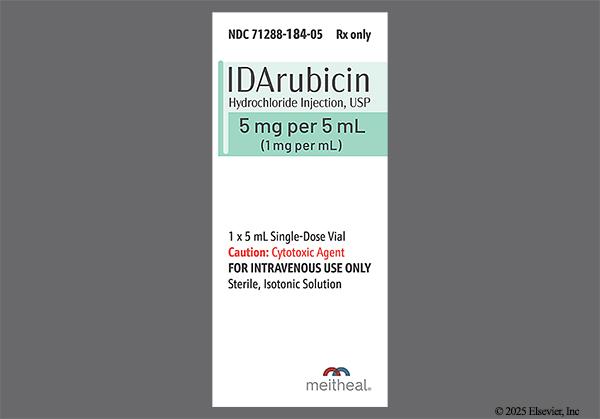 Idarubicin Hydrochloride 5mg/5ml Solution for Injection

