

Dexcom vs. FreeStyle Libre: How Do These Continuous Glucose Monitors Compare?
Don’t know the differences between continuous glucose monitors (CGMs)? Compare the Freestyle Libre and Dexcom functions and see how these CGMs compare.
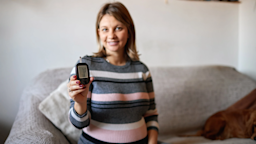
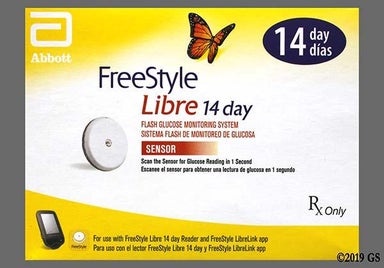
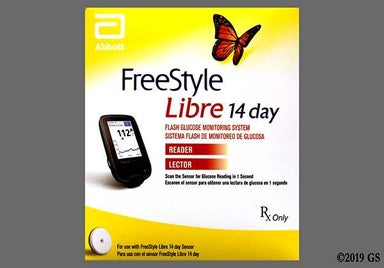
FreeStyle Libre 14 Day is a continuous glucose monitoring (CGM) system that you wear on your skin. It's designed to replace fingersticks in adults with diabetes. It measures your glucose (sugar) levels every minute throughout the day to better help you keep track of your daily patterns. The FreeStyle Libre 14 Day system uses a 14-day sensor that's inserted in your skin. It sends your glucose readings directly to your smartphone (through an app) or the FreeStyle Libre 14 Day handheld reader.

The FreeStyle Libre 14 Day system is made up of two parts that work together to measure and record your glucose levels throughout the day.
| Common Brands | FreeStyle Libre 14 Day System |
|---|---|
| Drug Class | Continuous glucose monitoring |
| Controlled Substance Classification | Not a controlled medication |
| Generic Status | No lower-cost generic available |
| Availability | Prescription only |



How to set up your FreeStyle Libre 14 Day:
How to start using your FreeStyle Libre 14 Day:
How to remove FreeStyle Libre 14 Day sensors:

FreeStyle Libre 14 Day can cause some serious health issues. This risk may be even higher for certain groups. If this worries you, talk to your doctor or pharmacist about other options.
You must remove FreeStyle Libre 14 Day before getting a magnetic resonance imaging (MRI), computed tomography (CT) scan, or high-frequency electrical heat (diathermy) treatment. These medical tests might damage the sensor and cause incorrect glucose readings. If you're scheduled for any medical tests or imaging, let your provider know that you're using FreeStyle Libre 14 Day.
If you're going through security, such as at the airport, let the security personnel know that you're wearing a CGM. Don't go through (or put any part of the FreeStyle Libre 14 Day system through) any body scanners or X-ray machines. Instead, request that they use another method for screening. It isn't known how X-rays or other scanners affect FreeStyle Libre 14 Day, and they could damage the sensor and affect its performance.
If you have symptoms of low or high blood sugar and they aren't matching up with your FreeStyle Libre 14 Day readings, always do a fingerstick blood sugar test and contact your provider. The FreeStyle Libre 14 Day reader has a built-in blood glucose meter, or you could use a separate blood glucose meter. The FreeStyle Libre 14 Day reader's built-in meter can only be used with FreeStyle Precision Neo blood glucose test strips.
FreeStyle Libre 14 Day doesn't have alarms that will alert you if you're having severely low or high blood sugar. In order to check your glucose level, you must scan your sensor.
Severe dehydration (low fluids in the body) can cause your glucose readings to be inaccurate. If you're having trouble staying hydrated, contact your healthcare provider.
Taking vitamin C (ascorbic acid) and products that contain salicylic acid (e.g., aspirin, certain skin care products) can affect the accuracy of the glucose readings from FreeStyle Libre 14 Day. Vitamin C can cause your glucose readings to be falsely high. This can raise your risk for dangerously low blood sugar levels. Aspirin can lower your glucose readings. Vitamin C and aspirin are commonly found in cold remedies. If you're not sure if a product contains these ingredients, ask your pharmacist for help.
The FreeStyle Libre 14 Day sensors have an adhesive that keeps them attached to your skin. If you notice redness, swelling, or a lot of irritation around or under your sensor, remove the sensor and contact your healthcare provider.
The FreeStyle Libre 14 Day sensors are only meant for single use. Don't reuse or share them with anyone else. If you reuse them, you might get inaccurate glucose readings. Reusing or sharing sensors raises the risk of infection. If your sensor becomes loose, remove it and apply a new sensor.

 Box
Box| Dosage | Quantity | Price as low as | Price per unit |
|---|---|---|---|
| 1 glucose meters of 14 day flash glucose monitoring system reader | 2 boxes | $153.10 | $76.55 |


Contraindications are specific health conditions or situations in which a person should not take a medication due to safety concerns. If you have any of the following conditions or if any of the following apply to you, let your healthcare provider know because FreeStyle Libre 14 Day will not be safe for you to take.



Prescription savings
Stop paying too much for your prescriptions. Compare prices, get pharmacy coupons, and save up to 80%. Find expert answers to your health questions so you can make the best decisions for yourself and your family.
Health conditions
Medications & treatment
Access & affordability
 Our monthly healthcare membership can help you save thousands on your prescription costs.
Resources

Yes. All CGMs currently require a prescription, including FreeStyle Libre.
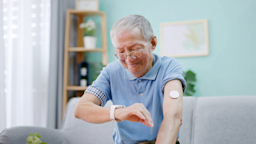
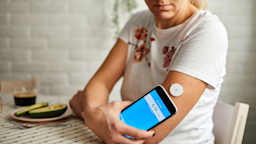
The FreeStyle Libre CGM sensor is the part of the system that's inserted into the skin. You'll do so using the sensor applicator. Before applying your sensor, wash the area on the back of your upper arm where you'll be placing it. Clean the site with an alcohol swab and let it dry. Choose a spot that has a low chance of the sensor being knocked off. Then, prepare the sensor applicator and push it down firmly on your skin to apply the sensor.
In a small study done by the manufacturer, 92% of people agreed applying the FreeStyle Libre sensor was painless.
To turn your FreeStyle Libre reader off, press and hold down the home button. To turn it back on, press the home button once. You can check if the reader is working properly by selecting the settings symbol from the home screen, and then selecting "system status" and "reader test". If your reader isn't turning on at all, it might be because the battery is too low or because the temperature is too hot (the reader works within a temperature range of 50°F and 113°F). If you have questions about your reader, contact customer service at 1-855-632-8658.
To remove your sensor, find the edge of the adhesive. Pull up on it and slowly peel away from your skin. You'll need to replace your FreeStyle Libre sensor every 14 days. After this time, your glucose readings might not be accurate.
Yes, you can shower with FreeStyle Libre. The sensors are water-resistant, but you shouldn't take them deeper than 3 feet of water or let them be in water for longer than 30 minutes. Please note that the FreeStyle Libre reader isn't water-resistant, so you should avoid getting it wet.
FreeStyle Libre has an overall mean absolute relative difference (MARD) of 9.4%. The MARD is the typical measurement used to test how accurate a CGM is. It compares the difference between the glucose level measured by the CGM and glucose level of the blood. The smaller the MARD, the more accurate the CGM. Based on industry standards, a CGM with a MARD less than 10% is considered to be fairly accurate and reliable. Keep in mind that the readings might be different from the numbers you get from a fingerstick test for a few different reasons. If you aren't sure if the result is correct from your sensor, always do a blood glucose fingerstick test to confirm. This is especially important if you have symptoms of low blood sugar.
