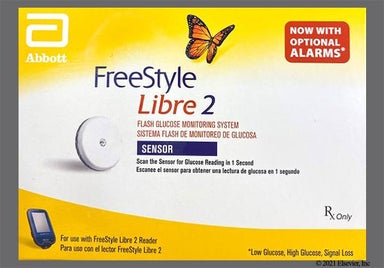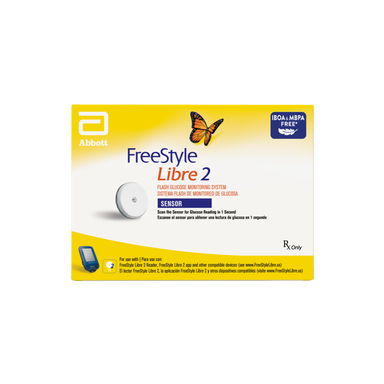
FreeStyle Libre 2
FreeStyle Libre 2 is a continuous glucose monitoring (CGM) system that's designed to replace fingersticks and lessen the need for test strips in people with diabetes. It measures your glucose levels every minute throughout the day to better help you manage your blood sugar. The FreeStyle Libre 2 system uses a sensor that's attached to your skin on the back of your upper arm. You can scan the sensor and have the glucose reading displayed on an app in your smartphone (compatible phones only), or the FreeStyle Libre 2 handheld reader. The sensor must be replaced every 14 days, and the sensors require a prescription.


What is FreeStyle Libre 2?
What is FreeStyle Libre 2 used for?
- Monitor glucose levels
How FreeStyle Libre 2 works
The FreeStyle Libre 2 system is made up of two parts that work together to measure and record your glucose levels throughout the day.
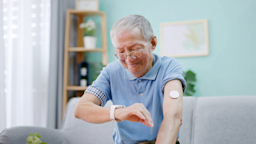
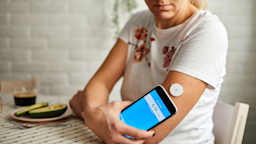
- Sensor: The sensor is attached to the skin on the back of your upper arm to measure your glucose levels from just below the skin.
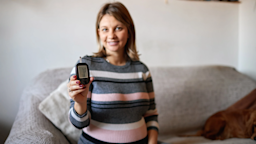
- Reader: The handheld reader displays and stores the readings. You can use the FreeStyle Libre 2 Reader or the FreeStyle Libre 2 app on your smartphone.
Drug facts

Get your GoodRx coupon

Pros and cons of FreeStyle Libre 2
Pros
- Can be used by people ages 4 years and older
- Can be used with the FreeStyle Libre 2 Reader or your smartphone
- Sensor lasts up to 14 days
Cons
- Sensor can only be placed on the back of the upper arm
- Must wait 60 minutes after placing a new sensor to check glucose
- Sensor must be stored between 36°F and 82°F to work properly

Pharmacist tips for FreeStyle Libre 2

How to set up your FreeStyle Libre 2:
- You can use either the FreeStyle Libre 2 handheld reader or a separate smart device (e.g., your smartphone) to display and store your glucose readings.
- If you're using a smart device, download the FreeStyle Libre 2 app. To connect FreeStyle Libre 2 to a smart device (e.g., a compatible phone), open the app and follow the instructions. Make sure your phone is connected to a WiFi or cellular network.
- If you're using the reader from FreeStyle Libre 2, set up FreeStyle Libre 2 to work with your reader with this guide.
How to start using your FreeStyle Libre 2:
- When you're ready to apply your FreeStyle Libre 2 sensor, first wash and dry your hands. Choose the place on the back of your upper arm where you want to insert the sensor and wipe the area with an alcohol wipe. Then, remove the sensor from its packaging and push down firmly against your skin to apply it.
- When the FreeStyle Libre 2 sensor is on your skin, pull the applicator away from your body. Make sure the sensor is secure. Watch the instructional video to learn more about applying your sensor.
- Each time you apply a new FreeStyle Libre 2 sensor, you'll need to wait 1 hour before you can check your glucose readings with the handheld reader or app on your smart device.
- If you're using the FreeStyle Libre 2 reader, press the home button to turn it on. Touch "start new sensor" and hold the reader within 1.5 inches from the sensor to scan it.
- If you're using a smart device, follow the instructions on the FreeStyle Libre 2 app to scan your sensor and view your glucose reading.
- Watch this video to learn more about getting your first reading with the FreeStyle Libre 2.
How to remove FreeStyle Libre 2 sensors:
- You'll need to replace your FreeStyle Libre 2 once every 14 days, or sooner if it becomes loose.
- To remove the sensor, find the edge of the adhesive on your sensor and pull up on it. Then, slowly peel the sensor off your skin.
- When applying a new sensor, choose a place on the back of your upper arm that's different from the most recent position. This will help prevent discomfort.
- Screw the used applicator and lid back together and throw it away in a sharps container or yellow biohazard bag. Your used sensors can be wiped down with disinfectant and thrown away as electrical waste, like a battery.

Common questions about FreeStyle Libre 2
The FreeStyle Libre 2 sensor lasts for up to 14 days. After this time, your glucose readings might not be accurate. If your sensor is loose or you're getting unreliable readings, it might be time to change it sooner. Don't try to reattach a sensor that came loose. Instead, apply a new sensor and call 1-855-632-8658.
The sensor should be placed on the back of your upper arm. Choose a spot that has a low chance of the sensor being knocked off. Make sure your skin is fully dry before applying the sensor. Don't place the sensor on other sites on your body because this might cause your glucose readings to be inaccurate. To prevent skin irritation, choose a different site on the back of your upper arms each time you change the sensor.
If you're using a new sensor for the first time, there's a 1-hour warm-up period after you put it on. This means it'll take 1 hour before the sensor can start reading your glucose levels because it needs time to get used to your body. During this time, you can still use the built-in meter on the handheld reader to check your blood sugar levels using FreeStyle Precision Neo Test Strips.
Yes. You can use FreeStyle Libre 2 with the FreeStyle Libre 2 app that's available to download on compatible devices. If you choose to use FreeStyle Libre 2 with the app, you don't need to use the FreeStyle Libre 2 Reader.
Yes, you can shower while wearing the FreeStyle Libre 2 sensor. The sensors are water-resistant, and you can wear it while bathing and swimming. But you shouldn't go deeper than 3 feet of water or let the sensor be under water for longer than 30 minutes. Please note that the FreeStyle Libre 2 reader isn't water resistant, so you should keep it dry.
FreeStyle Libre 2 has an overall mean absolute relative difference (MARD) of 9.2% for adults. The MARD for children ages 6 to 17 years old is 9.7%. The MARD is the typical measurement used to test how accurate a CGM is. It compares the difference between the glucose level measured by the CGM and glucose level of the blood. The smaller the MARD, the more accurate the CGM. Based on industry standards, a CGM with a MARD less than 10% is considered to be fairly accurate and reliable. Keep in mind that the readings might be different from the numbers you get from a fingerstick test for a few different reasons. If you aren't sure if the result is correct from your sensor, always do a blood glucose fingerstick test to confirm. This is especially important if you have symptoms of low blood sugar.
Both CGMs can measure glucose levels every minute for up to 14 days, and include water-resistant sensors that are placed onto the skin of the back of your upper arm. But there are a few differences between them. The FreeStyle Libre 2 system offers an optional handheld reader instead of using the app on a smart device, but the FreeStyle Libre 3 doesn't work with a reader (you must use an app on a smart device). Compared to the FreeStyle Libre 2, the FreeStyle Libre 3 is the newest, smallest, and thinnest CGM. If you have questions, your provider can help you select the best CGM for your needs.
FreeStyle Libre 2 and Dexcom G6 are two different brands of CGMs that take your glucose readings throughout the day. But they do have their differences: (1) FreeStyle Libre 2 can only be used in people 4 years or older, but Dexcom G6 can be used by children as young as 2 years old. (2) FreeStyle Libre 2 takes 1 hour to pair with the reader, while Dexcom G6 takes 2 hours to pair. (3) FreeStyle Libre 2 provides glucose readings every 1 minute, while Dexcom G6 provides glucose readings every 5 minutes. Read this article for more information and talk with your provider to choose the right CGM for you.

How to save using GoodRx


Risks and warnings for FreeStyle Libre 2
FreeStyle Libre 2 can cause some serious health issues. This risk may be even higher for certain groups. If this worries you, talk to your doctor or pharmacist about other options.
Warning for medical tests and imaging
You must remove FreeStyle Libre 2 before getting a magnetic resonance imaging (MRI), computed tomography (CT) scan, or high-frequency electrical heat (diathermy) treatment. These medical tests might damage the sensor and cause incorrect glucose readings. If you're scheduled for any medical tests or imaging, let your provider know that you're using FreeStyle Libre 2.
Warning for security machines
If you're going through security, such as at the airport, let the security personnel know that you're wearing a CGM. Don't go through (or put any part of the FreeStyle Libre 2 system through) any body scanners or X-ray machines. Instead, request that they use another method for screening, such as with a hand-wand, visual inspection, or a walk-through metal detector. It isn't known how X-rays or other scanners affect FreeStyle Libre 2, and they could damage the sensor and affect its performance.
Low or high blood sugar
If you have symptoms of low or high blood sugar and they aren't matching up with your FreeStyle Libre 2 readings, always do a fingerstick blood sugar test and contact your provider. If you're using the FreeStyle Libre 2 app, make sure to have a separate blood glucose monitor at home. While the FreeStyle Libre 2 reader has a built-in blood glucose monitor, the app doesn't have one.
Missed alarms
FreeStyle Libre 2 has optional alarms that must be turned on in the app or reader if you want to use them. In order for you to get alarms, your reader or phone must be within 20 feet of you at all times. If you're using a smart device, make sure that the Bluetooth setting is on. Keep your reader or device charged and turned on. The alarms won't include your glucose reading, so you'll need to scan your sensor to check your level.
Risk of vitamin C causing false blood sugar readings
Taking vitamin C (ascorbic acid) can affect the accuracy of the glucose readings from FreeStyle Libre 2. If you take more than 500 mg of vitamin C while wearing the sensor, your glucose readings might be falsely high. This can raise your risk for dangerously low blood sugar levels. Before taking any supplements, check how much vitamin C they contain. Vitamin C is commonly found in multivitamins and cold remedies. If you're not sure, ask your pharmacist for help.
Skin irritation
The FreeStyle Libre 2 sensors have an adhesive that keeps them attached to your skin. If you notice redness, swelling, or a lot of irritation around or under your sensor, remove the sensor and contact your healthcare provider.
Don't reuse sensors
The FreeStyle Libre 2 sensors are only meant for single use. Don't reuse or share them with anyone else. If you reuse them, you might get inaccurate glucose readings. Reusing or sharing sensors raises the risk of infection. If your sensor becomes loose, remove it and apply a new sensor.

FreeStyle Libre 2 dosage
 Box
Box| Dosage | Quantity | Price as low as | Price per unit |
|---|---|---|---|
| 1 glucose meter of reader | 1 box | $75.72 | $75.72 |
| 1 glucose meter of sensor | 2 boxes | $149.72 | $74.86 |
Typical dosage for FreeStyle Libre 2
- People ages 4 years and older: Place a new FreeStyle Libre 2 sensor on the skin of the back of the upper arm once every 14 days.

How much does FreeStyle Libre 2 cost?
$75.72

FreeStyle Libre 2 contraindications
Contraindications are specific health conditions or situations in which a person should not take a medication due to safety concerns. If you have any of the following conditions or if any of the following apply to you, let your healthcare provider know because FreeStyle Libre 2 will not be safe for you to take.
- Use with automated insulin dosing (AID) systems
- Getting magnetic resonance imaging (MRI), computed tomography (CT) scan, or high-frequency electrical heat (diathermy) treatment at the same time
- Age 3 years or younger
- Currently pregnant
- Currently on dialysis
- Currently seriously ill

What are alternatives to FreeStyle Libre 2?

News about FreeStyle Libre 2

FreeStyle Libre 2 images