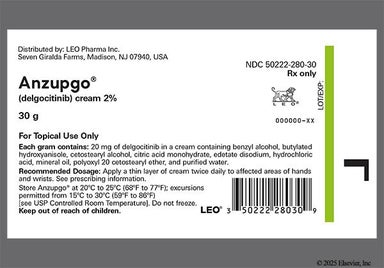
Anzupgo
Anzupgo (delgocitinib) is a cream used to treat moderate-to-severe chronic hand eczema (CHE) in adults. It might be prescribed if topical steroids don’t work well enough or if they aren't a good option for you. Anzupgo (delgocitinib) is a Janus kinase (JAK) inhibitor that helps improve itchiness and pain caused by eczema. It’s applied twice daily to the affected areas on the hands and wrists. Side effects include tingling or redness where you apply the cream. It might also raise your risk of infections.


What is Anzupgo (delgocitinib)?
What is Anzupgo (delgocitinib) used for?
- Moderate-to-severe chronic hand eczema (CHE) in adults
How Anzupgo (delgocitinib) works
Anzupgo (delgocitinib) is a Janus kinase (JAK) inhibitor. It works by blocking JAK, a protein in the body that plays a role in causing inflammation related to eczema.
By blocking JAK, Anzupgo (delgocitinib) helps lower inflammation caused by eczema. This improves symptoms of chronic hand eczema like redness, itchiness, and pain.
Drug facts
| Common Brands | Anzupgo |
|---|---|
| Drug Class | JAK inhibitor |
| Controlled Substance Classification | Not a controlled medication |
| Generic Status | No lower-cost generic available |
| Availability | Prescription only |

Side effects of Anzupgo (delgocitinib)
The following side effects may get better over time as your body gets used to the medication. Let your healthcare provider know immediately if you continue to experience these symptoms or if they worsen over time.
Common Side Effects
- Pain, tingling, itching, or redness at the application site
- Skin infections
- Fingernail infections
- Low white blood cells
Less Common Side Effects
- Headache
- Back pain
- COVID-19 infection
- Cold-like symptoms
- Upper respiratory tract infection
Anzupgo (delgocitinib) serious side effects
Contact your healthcare provider immediately if you experience any of the following.
- Serious infections: fever, chills, tiredness, muscle aches, cough, diarrhea, rash, shortness of breath, confusion
- Non-melanoma skin cancer: a new or changing spot on the skin, a sore that doesn’t heal after several weeks, red patches or bumps on the skin
The following Anzupgo (delgocitinib) side effects have also been reported
Side effects that you should report to your care team as soon as possible:
- Allergic reactions—skin rash, itching, hives, swelling of the face, lips, tongue, or throat
- Infection—fever, chills, cough, or sore throat
Side effects that usually do not require medical attention (report these to your care team if they continue or are bothersome):

Pros and cons of Anzupgo (delgocitinib)
Pros
- A steroid-free topical option
- Reduces itchiness and pain caused by eczema
- Can typically improve symptoms within a few days
Cons
- Applied to the skin twice a day
- Only approved for adults specifically with eczema on the hands and wrists
- Increases the risk of getting an infection

Pharmacist tips for Anzupgo (delgocitinib)

- Before applying Anzupgo (delgocitinib), clean and dry your hands and wrists. Then, apply a thin layer of the cream to the affected areas.
- Only apply Anzupgo (delgocitinib) to the skin on your hands and wrists. Don’t put it in or near your eyes, mouth, nose, or vagina. If the cream accidentally gets into these areas, wash it off with water right away to prevent irritation or other side effects.
- Anzupgo (delgocitinib) comes as a 30 gram tube or a 60 gram tube. Don’t use more than 30 grams in 2 weeks or 60 grams in 1 month. Using more than this amount can increase the risk of side effects.
- Anzupgo (delgocitinib) can lower your immune system’s ability to fight infections. This can make it more likely that you can get sick. Some infections can be serious. So let your healthcare team know right away if you have any symptoms of an infection, such as a fever or chills.
- Before getting any vaccines, ask a healthcare professional if it’s safe for you. You shouldn't get any live vaccines right before starting, while you use Anzupgo (delgocitinib), and right after treatment ends. The medication can weaken your immune system, which can increase your risk of infection from the live vaccine itself.
- Anzupgo (delgocitinib) can increase the risk of non-melanoma skin cancers. When you’re outside, use a broad-spectrum sunscreen and wear sun-protective clothing to help protect your skin. It’s also important to do regular skin self-exams. If you notice any new or changing moles or blemishes, let your healthcare team know right away.
- Don’t use Anzupgo (delgocitinib) with other medications that weaken your immune system, such as steroids like triamcinolone. You also shouldn’t take other JAK inhibitors, such as Cibinqo (abrocitinib), at the same time. Otherwise, it can increase your risk of getting an infection.

Risks and warnings for Anzupgo (delgocitinib)
Anzupgo (delgocitinib) can cause some serious health issues. This risk may be even higher for certain groups. If this worries you, talk to your doctor or pharmacist about other options.
Serious infections
- Risk factors: Have an infection that doesn’t go away or keeps coming back | History of a serious infection | Have a condition that increases the risk of infections
Anzupgo (delgocitinib) might lower how well your immune system fights infections. This can increase your risk of getting a serious infection. For example, one person treated with Anzupgo (delgocitinib) had a severe skin infection called eczema herpeticum. This medication might also cause some viral infections to come back, which can lead to problems like shingles.
Before starting Anzupgo (delgocitinib), let your healthcare team know if you’ve had any serious infections in the past. This can include shingles, hepatitis B or C, or tuberculosis (TB). Also tell them if you currently have any other infections. Your care team can make sure this medication is safe for you.
If you notice any signs or symptoms of an infection, let your healthcare team know right away. Look out for a fever, chills, muscle aches, cough, or diarrhea. Your care team can check to see what’s going on and how to help. If the infection is serious, they might tell you to stop taking Anzupgo (delgocitinib) until the infection is gone.
Risk of non-melanoma skin cancers
- Risk factors: History of skin cancer | Exposure to UV light, including sunlight | Lighter skin color | Older age
Non-melanoma skin cancer has occurred in some people treated with Anzupgo (delgocitinib). To lower the risk of skin cancer, avoid sunlamps and try not to spend too much time in the sun. If you go outside during the day, wear sun-protective clothing and use broad-spectrum sunscreen. You should also get periodic skin examinations to check for any signs of skin cancer. Talk to your healthcare team if you’re worried about this risk.
Avoid live vaccines
You shouldn’t get any live vaccines right before, during, and right after treatment with Anzupgo (delgocitinib). Examples of live vaccines include MMR (measles, mumps, and rubella vaccine) and FluMist, the nasal spray flu vaccine. Anzupgo (delgocitinib) weakens your immune system. This can make it more likely for you to get a serious infection from a live vaccine.
If possible, you should get any recommended immunizations before starting Anzupgo (delgocitinib). Talk to your primary care provider about which ones you need.
Potential risks related to JAK inhibition
It’s unknown whether Anzupgo (delgocitinib) causes the same risks as other JAK inhibitors. JAK inhibitors have been shown to increase cholesterol in some people.
In a study of an oral JAK inhibitor taken with methotrexate, people 50 years of age or older with rheumatoid arthritis (RA) and at least one heart condition had an increased risk of serious problems. These included blood clots, cancer, and even death. But this might not apply to Anzupgo (delgocitinib) because it isn’t taken by mouth and isn’t used for RA.
Talk to your healthcare team if you’re worried about the risks with Anzupgo (delgocitinib).

Anzupgo (delgocitinib) dosage
 Tube of cream
| Dosage | Quantity | Price as low as | Price per unit |
|---|---|---|---|
| 30g of 2% | 1 tube | $1,998.60 | $1,998.60 |

How much does Anzupgo (delgocitinib) cost?
$1,998.60

What are alternatives to Anzupgo (delgocitinib)?

Anzupgo (delgocitinib) images