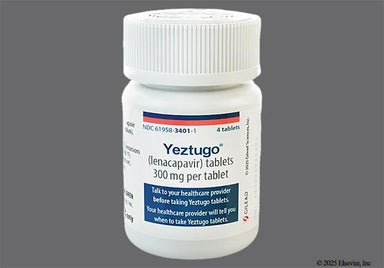
Yeztugo
Yeztugo (lenacapavir) works as an HIV-1 capsid inhibitor. It's used for pre-exposure prophylaxis (PrEP) to lower your risk of getting human immunodeficiency virus (HIV) from sex. It's for HIV-negative adults and adolescents who weigh at least 77 lbs at risk of getting HIV. Yeztugo (lenacapavir) starts with two injections under the skin plus tablets taken by mouth on day 1, then only tablets on day 2. After that, you get two injections every 6 months. If an injection will be late, you might need to take the tablets once weekly as a temporary bridge. Side effects include injection site reactions and headache.


What is Yeztugo (lenacapavir)?
What is Yeztugo (lenacapavir) used for?
- Prevention of HIV infection (PrEP or pre-exposure prophylaxis)
How Yeztugo (lenacapavir) works
Yeztugo (lenacapavir) is a capsid inhibitor. It attaches to the HIV capsid, which is the outer protein shell that protects the virus' DNA and proteins. By attaching to this shell, the medication blocks several steps HIV uses to enter healthy cells and make copies of itself.
Drug facts
| Common Brands | Yeztugo |
|---|---|
| Drug Class | Capsid inhibitor |
| Controlled Substance Classification | Not a controlled medication |
| Generic Status | No lower-cost generic available |
| Availability | Prescription only |

Side effects of Yeztugo (lenacapavir)
The following side effects may get better over time as your body gets used to the medication. Let your healthcare provider know immediately if you continue to experience these symptoms or if they worsen over time.
Common Side Effects
- Injection site reactions (e.g., lump, pain; up to 83%)
- Headache (up to 7%)
- Nausea (up to 5%)
Less Common Side Effects
- Dizziness
- Vomiting
- Diarrhea
Yeztugo (lenacapavir) serious side effects
Contact your healthcare provider immediately if you experience any of the following.
- Serious injection site problems: worsening pain, skin breakdown, open sores (ulcers), blackened or dead skin, signs the injection wasn’t placed under the skin
The following Yeztugo (lenacapavir) side effects have also been reported
Side effects that you should report to your care team as soon as possible:
- Allergic reactions—skin rash, itching, hives, swelling of the face, lips, tongue, or throat
Side effects that usually do not require medical attention (report these to your care team if they continue or are bothersome):

Pros and cons of Yeztugo (lenacapavir)
Pros
- Long-acting HIV prevention; only need injections every 6 months after the first starting doses
- Works across diverse groups at high risk of HIV
- Okay for most people with kidney problems
Cons
- Must test negative for HIV before starting and at every injection visit
- Common to have injection site lumps and pain, which can last a while
- Can interact with some medications like seizure medications, antifungals, and herbal products

Pharmacist tips for Yeztugo (lenacapavir)

- On day 1, you get Yeztugo (lenacapavir) injections under your skin and take tablets of the medication by mouth at a medical office. On day 2, you take the tablets at home. After that, you get Yeztugo (lenacapavir) injections once every 6 months at the medical office.
- You can take Yeztugo (lenacapavir) tablets with or without food. Swallow them whole with water. Store the tablets at room temperature (68°F to 77°F) in the original bottle with the drying packet inside.
- Put the dates of your Yeztugo (lenacapavir) injections on your calendar. This helps you remember when to get them. Staying on time helps the medication work the best it can to prevent HIV infection.
- Call your care team if you think your Yeztugo (lenacapavir) injection will be more than 2 weeks late, such as if you're going on vacation. Your prescriber might recommend a tablet bridge. This means you take a Yeztugo (lenacapavir) tablet once a week for a short time until you can get your next injection. This helps your protection stay steady.
- Yeztugo (lenacapavir) can cause a small lump, mild pain, or redness where you get the injection. Lumps are common and can last for months, but they usually get smaller over time. You can use an ice pack wrapped in a towel to help with pain. Call your care team if the reaction bothers you, gets worse, or if an open sore forms.
- Don’t skip HIV testing while you're taking Yeztugo (lenacapavir). You’ll need to get tested for HIV the day you start Yeztugo (lenacapavir) and before each injection. If you feel sick with a fever, sore throat, body aches, or a new rash, let your care team know and get tested again.
- Yeztugo (lenacapavir) helps prevent HIV, but it doesn’t prevent other sexually transmitted infections (STIs). Keep using condoms during sex and get regular STI checks. This helps protect yourself and your partners.
- Always talk to your care team before starting or stopping any medications. Yeztugo (lenacapavir) can interact with some medications, like certain seizure medications and tuberculosis treatments. Others include herbal products like St. John’s wort. They can lower your protection against HIV or cause more side effects. If needed, your care team can adjust your medications to lower your risk of problems.
- After you stop Yeztugo (lenacapavir), keep checking with your care team before starting any new prescriptions or over-the-counter medications. Yeztugo (lenacapavir) can stay in your body for many months. Because of this, it can affect other medications for several months even after you stop taking it.
- If you stop taking Yeztugo (lenacapavir), talk to your care team about continuing PrEP. They might recommend another PrEP option soon after your last injection to keep you protected.

Risks and warnings for Yeztugo (lenacapavir)
Yeztugo (lenacapavir) can cause some serious health issues. This risk may be even higher for certain groups. If this worries you, talk to your doctor or pharmacist about other options.
Take extra steps to prevent HIV and other sexually transmitted infections (STIs)
- Risk factors: Having sex without using a condom | Current or past STIs | Having a sexual partner with unknown HIV status | Living in an area where HIV is common
 Yeztugo (lenacapavir) can help lower your risk of getting HIV. But it works best when used with other protection methods. Besides getting your injections on time, practice safer sex, like using condoms. Also, get tested for STIs regularly.
Your care team will test you for HIV before starting Yeztugo (lenacapavir). They'll also test before every injection and any time you have symptoms that could be from an HIV infection.
Tell your care team if you have symptoms of HIV either before or during treatment. Look out for a fever, sore throat, feeling tired, night sweats, chills, muscle pain, and skin rash.
Risk of HIV resistance
- Risk factors: Starting Yeztugo (lenacapavir) with undiagnosed HIV | Getting HIV while on Yeztugo (lenacapavir) or soon after stopping | Missing injections
There’s a chance that HIV could become harder to treat if you get infected before starting Yeztugo (lenacapavir). It's also possible if you get infected while taking this medication or shortly after stopping it.
To help prevent this, your prescriber will test you for HIV before each Yeztugo (lenacapavir) injection session. This makes sure you’re still HIV-negative. If you test positive, you’ll need to switch to a complete HIV treatment.
If you stop taking Yeztugo (lenacapavir) but are still at risk of HIV, your prescriber might recommend another type of PrEP. This helps you stay protected.
Risk of losing protection with missed or delayed injections
Yeztugo (lenacapavir) can stay in your body for up to 12 months or longer after your last injection. This is helpful for long‑term protection against HIV. But it's still important to get your injections on time (once every 6 months). If you miss or delay injections, your protection can drop.
Tell your prescriber if you miss or need to delay a Yeztugo (lenacapavir) injection. They might recommend another PrEP option to bridge that window and keep you protected.
Long-acting effects of the injection and drug interactions
Yeztugo (lenacapavir) can stay in your body for a long time. Because of this, it can interact with other medications even months after your last dose. Some interactions can make Yeztugo (lenacapavir) work less well and affect how well it can protect you from HIV. Other interactions can raise your risk of side effects. Examples include antifungals, seizure medications, and St. John's Wort.
Tell your care team about any new prescriptions, over‑the‑counter medications, or herbal products you take. They can check for dangerous drug interactions and make changes to your treatment plan if needed to keep you safe.
Serious injection site reactions with improper administration
Yeztugo (lenacapavir) must be injected under the skin by a trained healthcare professional. Rarely, shots placed too shallow can cause serious problems. This can include ulcers on the skin or skin tissue death (necrosis). Call your care team if you have pain that gets worse, open sores, or skin breakdown where you got your injections.

Yeztugo (lenacapavir) dosage
Typical dosage for Yeztugo (lenacapavir)
Yeztugo (lenacapavir) is available as an injection (463.5 mg) and tablet (300 mg).
-
Starting dose day 1: A trained healthcare professional will give you 2 injections (a total of 927 mg) under the skin once. You'll also take 2 tablets (a total of 600 mg) by mouth once. Both are done at a medical office.
-
Starting dose day 2: Take 2 tablets (a total of 600 mg) by mouth once at home.
-
Maintenance dose: A healthcare professional will give you 2 injections (a total of 927 mg) under the skin. They're given once every 6 months from the date of your last injection at a medical office.

Yeztugo (lenacapavir) contraindications
Contraindications are specific health conditions or situations in which a person should not take a medication due to safety concerns. If you have any of the following conditions or if any of the following apply to you, let your healthcare provider know because Yeztugo (lenacapavir) will not be safe for you to take.
- Unknown or positive HIV-1 status

What are alternatives to Yeztugo (lenacapavir)?

Yeztugo (lenacapavir) images