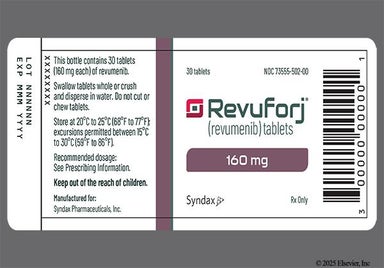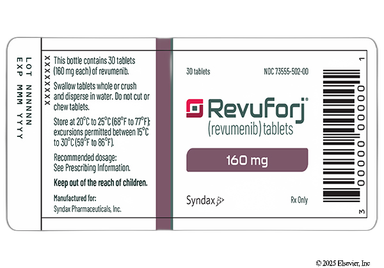
Revuforj
Revuforj (revumenib) is a menin inhibitor used to treat certain types of leukemia, a blood cancer. It’s FDA‑approved for adults and children 1 year and older with relapsed or refractory acute leukemia that has a KMT2A gene rearrangement or an NPM1 mutation. The medication comes as a pill taken by mouth twice a day, about 12 hours apart. Common side effects include nausea, bleeding, and infection.


What is Revuforj (revumenib)?
What is Revuforj (revumenib) used for?
- Acute leukemia with a KMT2A gene arrangement that has come back or hasn't improved after previous treatment - people 1 year and older
- Acute myeloid leukemia (AML) with a NPM1 mutation, that has come back or hasn't improved after previous treatment - people 1 year and older
How Revuforj (revumenib) works
Revuforj (revumenib) is a menin inhibitor, meaning it blocks a protein called menin. Menin helps leukemia cells grow when certain gene changes are present, such as KMT2A rearrangements or NPM1 mutations.
By blocking menin, Revuforj (revumenib) helps slow down or stop the growth of leukemia cells. This allows healthy blood cells to grow and develop, which can improve your blood counts over time.
Drug facts
| Common Brands | Revuforj |
|---|---|
| Drug Class | Menin inhibitor |
| Controlled Substance Classification | Not a controlled medication |
| Generic Status | No lower-cost generic available |
| Availability | Prescription only |

Side effects of Revuforj (revumenib)
The following side effects may get better over time as your body gets used to the medication. Let your healthcare provider know immediately if you continue to experience these symptoms or if they worsen over time.
Common Side Effects
- Higher phosphate levels (51%)
- Nausea (48%)
- Bleeding (48%)
- Infection (up to 46%)
- Higher liver enzymes (up to 44%)
- Higher creatinine (38%)
- Fever with low white blood cells (37%)
- Muscle or bone pain (37%)
- Abnormal heart rhythm (36%)
- Lower potassium levels (34%)
- Diarrhea (29%)
- Higher triglycerides (27%)
- Differentiation syndrome (25%)
- Lower phosphate levels (25%)
- Tiredness (24%)
- Swelling (24%)
- Reduced appetite (20%)
Less Common Side Effects
- Fast heart rate
- Cataract
- Stomach pain
- Low sodium levels
- High potassium levels
- Changes in taste
- Headache
- Fainting
- Tingling or numbness
- Kidney problems
- Rash
Revuforj (revumenib) serious side effects
Contact your healthcare provider immediately if you experience any of the following.
- Differentiation syndrome: fever, cough, shortness of breath, severe headache, confusion, dizziness or lightheadedness, sudden weight gain, swelling in arms/legs/neck/groin/underarm, urinating less, rash
- Heart rhythm changes: fainting, fast or irregular heartbeat, dizziness, feeling lightheaded
The following Revuforj (revumenib) side effects have also been reported
Side effects that you should report to your care team as soon as possible:
- Allergic reactions—skin rash, itching, hives, swelling of the face, lips, tongue, or throat
- Bleeding—bloody or black, tar-like stools, vomiting blood or brown material that looks like coffee grounds, red or dark brown urine, small red or purple spots on skin, unusual bruising or bleeding
- Fever, cough, dizziness, feeling faint or lightheaded, shortness of breath, bone pain, sudden weight gain, swelling of the ankles, hands, or feet, which may be signs of differentiation syndrome
- Heart rhythm changes—fast or irregular heartbeat, dizziness, feeling faint or lightheaded, chest pain, trouble breathing
- Infection—fever, chills, cough, sore throat, wounds that don't heal, pain or trouble when passing urine, general feeling of discomfort or being unwell
Side effects that usually do not require medical attention (report these to your care team if they continue or are bothersome):
- Constipation
- Diarrhea
- Loss of appetite
- Muscle pain
- Nausea

Pros and cons of Revuforj (revumenib)
Pros
- First medication to target specific genetic mutations (KMT2A or NPM1)
- Oral tablets that can be swallowed or prepared in water if needed
- Safe for adults and children 1 year and older
Cons
- Requires frequent ECGs and blood tests
- Can cause serious side effects like differentiation syndrome and heart rhythm changes
- Interacts with many medications

Pharmacist tips for Revuforj (revumenib)

- Take Revuforj (revumenib) twice a day, about 12 hours apart, at the same times each day. You can take it on an empty stomach or with a low‑fat meal (about 400 calories and ≤25% fat). Taking it the same way each day helps it work properly.
- Swallow Revuforj (revumenib) tablets whole with water. If you or your child can’t swallow tablets, you can crush and mix them with water, then give the dose with an oral syringe. Use the mixed dose within 2 hours.
- Revuforj (revumenib) tablets come in different strengths, and each strength is a different color. You might need to take more than one strength. Make sure you understand how many tablets to take and which ones to use.
- Revuforj (revumenib) can cause a serious side effect called differentiation syndrome. Call your care team or go to the ER right away if you have fever, trouble breathing, rash, fast weight gain, swelling, dizziness, confusion, or urinate less than usual.
- You’ll need heart monitoring while taking Revuforj (revumenib). An electrocardiogram (ECG or EKG) will be done before you start, weekly for the first 4 weeks, and then at least monthly. This checks for abnormal heart rhythm, which can cause fainting or loss of consciousness.
- Your care team will check your potassium and magnesium levels during treatment with Revuforj (revumenib). Low levels can raise your risk of heart rhythm problems. Do not start supplements unless your oncologist tells you to.
- Revuforj (revumenib) can lower white blood cells or affect platelets. Call your care team right away if you have fever, chills, sore throat, unusual bruising, nosebleeds, or blood in your stool or urine.
- Tell your care team about all medications and supplements before starting Revuforj (revumenib). Some medications can change how Revuforj (revumenib) works, while others can raise your risk of heart rhythm problems. Your dose might need to be adjusted.
- Avoid grapefruit or grapefruit juice while taking Revuforj (revumenib). It can change how your body processes the medication and increase side effects.
- If you miss a dose of Revuforj (revumenib), take it as soon as you remember if it's at least 12 hours before your next dose. Don't take two doses within 12 hours or double up the next day.
- Pregnancy: Revuforj (revumenib) can harm an unborn baby. Use effective birth control during treatment and for 4 months after the last dose (for you or your partner).
- Breastfeeding: Don't breastfeed while taking Revuforj (revumenib) and for 1 week after your last dose. It's not known if this medication passes into breast milk.
- Store Revuforj (revumenib) at room temperature in the original bottle with the drying packet inside. Keep the child-resistant cap tightly closed.
How prepare a dose dispersed in water:
- Crush the prescribed tablets in a clean, dry pill crusher.
- Mix the crushed powder with 10 mL of room‑temperature water in a small cup. Swirl every 30 seconds to 1 minute for about 5 minutes, then draw the liquid into a 20 mL oral syringe and give it within 2 hours.
- Add another 10 mL of water to the cup and swirl to rinse any remaining medication. Draw the liquid into a 20 mL oral syringe and give it within 2 hours to make sure the full dose is taken.

Risks and warnings for Revuforj (revumenib)
Revuforj (revumenib) can cause some serious health issues. This risk may be even higher for certain groups. If this worries you, talk to your doctor or pharmacist about other options.
Differentiation syndrome
- Risk factors: High white blood cell count
 Revuforj (revumenib) can cause a serious and sometimes life-threatening condition called differentiation syndrome. This happens when cancer cells mature quickly after starting treatment, which can trigger sudden inflammation in your body.
Watch for symptoms such as fever, trouble breathing, low oxygen levels, fluid around your lungs or heart, fast weight gain or swelling, low blood pressure, kidney problems, rash, or confusion. Tell your care team right away if you notice any of these symptoms. You might need steroid treatment right away and close monitoring in the hospital.
Abnormal heart rate
- Risk factors: Electrolyte imbalances | Heart problems | Taking medications that also cause heart rhythm problems
Revuforj (revumenib) can cause a heart rhythm problem called QT prolongation, which changes the electrical activity of the heart. You’ll have an electrocardiogram (ECG or EKG) before starting treatment, weekly for the first 4 weeks, and then at least once a month. Your potassium and magnesium levels will also be checked and corrected if low, since low levels can raise the risk of heart rhythm problems.
Your risk is higher if you have certain heart conditions, electrolyte imbalances, or take other medications that affect heart rhythm. In these cases, you might need more frequent ECG monitoring. Tell your care team right away if you feel dizzy, faint, or notice a fast or irregular heartbeat.
Harm to unborn baby
Based on animal data and how the medication works, Revuforj (revumenib) can harm a developing baby. Use effective birth control during treatment and for 4 months after the last dose.

Revuforj (revumenib) dosage
Typical dosage for Revuforj (revumenib)
Your dose depends on your weight (or body surface area, BSA) and whether you take certain medications that interact with Revuforj (revumenib).
- Weight 40 kg (88 lb) or more: The typical dose is 270 mg by mouth twice a day.
- Also taking medications that interact with Revuforj (revumenib): The typical dose is 160 mg twice a day.
- Weight less than 40 kg (88 lb): The typical dose is 160 mg/m² of BSA by mouth twice a day. This dose can range from 25 mg to 220 mg twice a day.
- Also taking medications that interact with Revuforj (revumenib): The typical dose is 95 mg/m² by mouth twice a day.
Your dose might be different if you’re taking certain medications that interact with Revuforj (revumenib) and develop certain side effects.

Revuforj (revumenib) images