Qfitlia
Qfitlia (fitusiran) is used to prevent or reduce bleeding in people 12 years and older with hemophilia A or hemophilia B, with or without inhibitors. It belongs to a group of medications called small interfering RNAs (siRNAs). The medication is given as an injection under the skin, most often once every 2 months. Qfitlia (fitusiran) comes as a prefilled pen or a vial for injection. Common side effects include viral infections, cold symptoms, and bacterial infections.


What is Qfitlia (fitusiran)?
What is Qfitlia (fitusiran) used for?
- To prevent or reduce bleeding episodes in people 12 years and older with hemophilia A or B, with or without factor VIII or IX inhibitors
How Qfitlia (fitusiran) works
Qfitlia (fitusiran) is a siRNA. It works by lowering levels of a natural protein called antithrombin. That lets your body make more thrombin, a clotting factor that helps your blood form clots. As a result, it can reduce how often you have bleeding episodes, even if you have inhibitors (proteins that interfere with clotting factors).
Drug facts
| Common Brands | Qfitlia |
|---|---|
| Drug Class | siRNA |
| Controlled Substance Classification | Not a controlled medication |
| Generic Status | No lower-cost generic available |
| Availability | Prescription only |

Side effects of Qfitlia (fitusiran)
The following side effects may get better over time as your body gets used to the medication. Let your healthcare provider know immediately if you continue to experience these symptoms or if they worsen over time.
Common Side Effects
- Viral infection (29%)
- Cold symptoms (26%)
- Bacterial infection (11%)
- Liver injury (8%)
- Joint pain (8%)
Less Common Side Effects
- Injection‑site reactions
- Headache
- Cough
- Indigestion
- Stomach pain
Qfitlia (fitusiran) serious side effects
Contact your healthcare provider immediately if you experience any of the following.
- Blood clots: swelling/pain/redness in an arm or leg, chest pain, fast heartbeat, shortness of breath, coughing up blood, severe or persistent headache, confusion, trouble speaking, weakness on one side of the body, sudden vision changes or eye pain
- Gallbladder problems: sudden or ongoing upper‑right stomach pain, nausea, vomiting, indigestion
- Liver problems: loss of appetite, nausea, vomiting, right‑upper‑stomach pain, tiredness, itching, dark urine, pale stools, yellowing of the skin or eyes
The following Qfitlia (fitusiran) side effects have also been reported
Side effects that you should report to your care team as soon as possible:
- Allergic reactions—skin rash, itching, hives, swelling of the face, lips, tongue, or throat
- Blood clot—pain, swelling, or warmth in the leg, shortness of breath, chest pain
- Gallbladder problems—severe stomach pain, nausea, vomiting, fever
- Liver injury—right upper belly pain, loss of appetite, nausea, light-colored stool, dark yellow or brown urine, yellowing skin or eyes, unusual weakness or fatigue
Side effects that usually do not require medical attention (report these to your care team if they continue or are bothersome):
- Cough
- Headache
- Pain, redness, irritation, or bruising at the injection site
- Runny or stuffy nose
- Sore throat

Pros and cons of Qfitlia (fitusiran)
Pros
- Works for hemophilia A and B, with or without inhibitors
- Injections as few as every 2 months for many people
- Comes as a vial or prefilled pen
Cons
- Boxed warning for blood clots and gallbladder problems
- Requires regular blood tests to adjust dose and check liver health
- Can interact with other clotting treatments, raising clot risk

Pharmacist tips for Qfitlia (fitusiran)

- Before using Qfitlia (fitusiran), your care team will teach you how to give the injection safely. Read the Instructions for Use and ask your prescriber if you have questions.
- Qfitlia (fitusiran) should be given by an adult or with adult supervision for children 12 to 17 years old.
- Keep your lab appointments while using Qfitlia (fitusiran). Your dose is adjusted based on an antithrombin (AT) blood test. This helps your care team keep your AT in the safe target range to prevent bleeding and lower clot risk.
- During the first 7 days of Qfitlia (fitusiran), your prescriber might lower doses or space out other clotting treatments. Using regular doses at the same time can raise your risk of blood clots. Talk to your prescriber about how to manage breakthrough bleeds.
- Watch for signs of blood clots while using Qfitlia (fitusiran). Get medical help right away if you have leg pain or swelling, chest pain, trouble breathing, severe headache, or sudden vision or speech changes.
- Pay attention to possible gallbladder problems while using Qfitlia (fitusiran). Symptoms can include pain in the upper right stomach, nausea, vomiting, or indigestion. Contact your care team if these happen.
- Qfitlia (fitusiran) can raise liver enzymes, so you’ll need regular blood tests to check your liver health. Watch for signs like yellowing of the skin or eyes or dark urine.
- Tell every clinician that you use Qfitlia (fitusiran). This is important before surgery or dental work to help prevent bleeding or blood clots.
- Discuss birth control if you’re able to become pregnant. Some hormonal contraceptives might raise clot risk when used with Qfitlia (fitusiran), so ask about non‑hormonal options.
- If you miss a dose of Qfitlia (fitusiran), take it as soon as you remember. Then, resume your regular monthly or every‑other‑month schedule based on your last dose as instructed by your prescriber.
- Store Qfitlia (fitusiran) in the refrigerator in its original carton. If needed, you can keep the vials at room temperature until the expiration date or the prefilled pen at room temperature for one 3-month period. If you store it at room temperature, don’t put it back in the refrigerator.
How to inject Qfitlia (fitusiran)
- Qfitlia (fitusiran) comes as a prefilled pen or vial. You can inject it under the skin in your thigh or stomach (at least 2 inches away from your belly button), or a caregiver can use the upper arm. Avoid skin that is irritated, bruised, or scarred.
- Let Qfitlia (fitusiran) warm to room temperature for about 30 minutes if it was in the refrigerator. This can make the injection more comfortable.
- Before using Qfitlia (fitusiran), wash your hands and clean the injection site with an alcohol swab. Let the area dry before injecting.
- If using the vial: Remove the cap and wipe the rubber stopper with an alcohol swab. Attach the needle to the syringe and remove the needle cap. Then, push the needle through the rubber vial stopper and turn the vial upside down to draw up your dose.
- If using the pen: Make sure the window isn't yellow (this means the pen has been used). Remove the cap, place it at a 90° angle on the injection site. Press down until you hear a click, and wait for the second click to finish. The window should be fully yellow, and you can remove the pen from your skin at this time.
- After injecting, throw away the Qfitlia (fitusiran) vial, pen, needle, and syringe in a sharps container.

Risks and warnings for Qfitlia (fitusiran)
Qfitlia (fitusiran) can cause some serious health issues. This risk may be even higher for certain groups. If this worries you, talk to your doctor or pharmacist about other options.
Blood clots
- Risk factors: Low AT levels | High dose | Conditions that have a higher clot risk | Indwelling venous catheter | Treatment of breakthrough bleeding episodes
 Blood clots have been reported with Qfitlia (fitusiran). Your risk might be higher if your antithrombin (AT) levels drop too low, if you have other conditions that have a higher clot risk, or if you use standard doses of other clotting treatments at the same time. Your care team will check your AT levels regularly and adjust your dose to keep you in a safe range.
Get medical help right away if you have symptoms of a blood clot, such as chest pain, trouble breathing, swelling in your arms or legs, a severe headache, or sudden vision or speech changes. If a blood clot happens, your care team might stop Qfitlia (fitusiran) and decide if it’s safe to restart it.
Gallbladder problems
- Risk factors: History of gallbladder problems
Gallstones and gallbladder inflammation have occurred in some people receiving Qfitlia (fitusiran). In some cases, people needed gallbladder surgery or had complications such as pancreatitis.
Watch for symptoms like pain in the upper-right side of your stomach, nausea, vomiting, or indigestion. Your prescriber may pause or stop Qfitlia (fitusiran) if gallbladder problems occur. Get medical care right away if you have severe pain or a fever along with stomach pain.
Liver damage
- Risk factors: History of liver problems | High dose
Qfitlia (fitusiran) can raise liver enzymes, which can be a sign of liver damage. Your care team will check your liver with blood tests before you start treatment, every month for at least 6 months, and after any dose changes. Tell your prescriber if you notice symptoms like yellowing of your skin or eyes, dark urine, or unusual tiredness.

Qfitlia (fitusiran) dosage
Typical dosage for Qfitlia (fitusiran)
The typical starting dose is 50 mg injected under the skin once every 2 months. Your prescriber will adjust the dose as needed based on your blood tests.

What are alternatives to Qfitlia (fitusiran)?

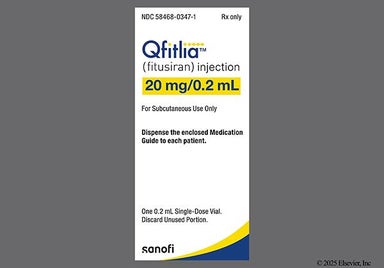
Qfitlia (fitusiran) images