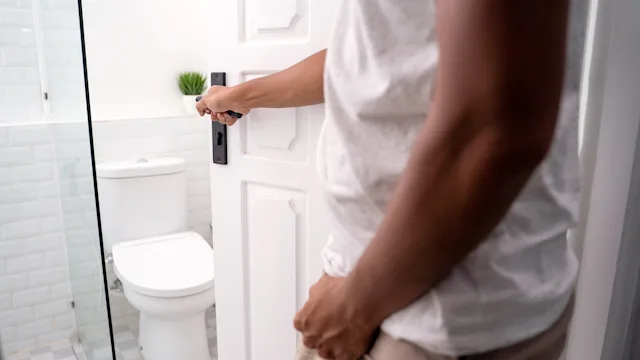
“Women who have incontinence will very often dehydrate themselves and decrease their fluid intake in a common sense attempt to reduce bladder fullness so they reduce their incontinence,” says Lauri Romanzi, MD, a urogynecologist in New York City.
But the problem with dramatically cutting back your fluid intake too much is that you’re not only dehydrating your body, but your making your urine more concentrated too (hence the darker color). This extra-concentrated urine can irritate the bladder and make your OAB symptoms worse. (Here’s what else your urine color can reveal about your health).
Lauri Romanzi, MD
Dr. Romanzi is a Urogynecologist and Reconstructive Pelvic Surgeon based in New York City.
References
GoodRx Health has strict sourcing policies and relies on primary sources such as medical organizations, governmental agencies, academic institutions, and peer-reviewed scientific journals. Learn more about how we ensure our content is accurate, thorough, and unbiased by reading our editorial guidelines.
University of California, San Francisco. (n.d.). Constipation.
Brittany Doohan was the Content Director at HealthiNation and is currently the Editorial Director at Medscape. Through her work with Medscape, she won a Silver Telly Award in May 2022 for "Sleepless Nation: A Public Health Epidemic — Episode 2: A Decade Without a Diagnosis." She has worked in health journalism and video production for more than 8 years, and loves the challenge of explaining complex topics in an easy-to-understand and creative way.
Search is powered by a third party. By clicking a topic in the advertisement above, you agree that you will visit a landing page with search results generated by a third party, and that your personal identifiers and engagement on this page and the landing page may be shared with such third party. GoodRx may receive compensation in relation to your search.