Heart Attack: Your GoodRx Guide
Comprehensive information for you or a loved one — including treatment options and discounts on popular medications.

A heart attack — or myocardial infarction — is a serious medical condition that always requires emergency medical care. It happens when the heart muscle is deprived of nutrient-rich blood for long enough to damage the pumping walls of the heart.
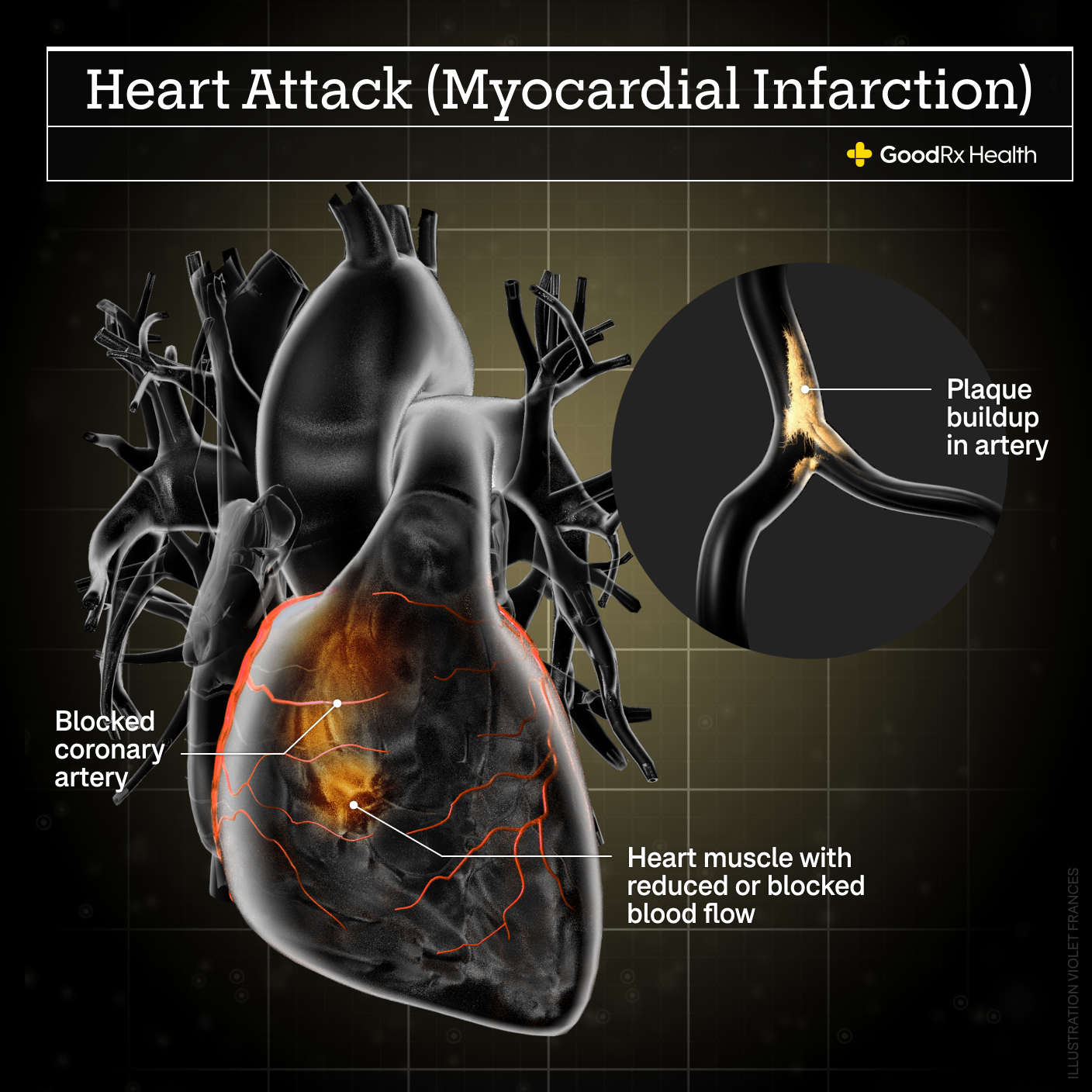
The cause is usually a blockage — or clot — in the coronary arteries. These are the small arteries that supply the heart muscle with the blood it needs to keep beating. Depending on which coronary arteries are affected, how many are affected, and how much time goes by before a person receives treatment, the impact can range from mild to deadly.
Heart attacks are common. Over 800,000 people in the U.S. have a heart attack every year. Heart attacks are the leading cause of death in the U.S. as well.


Heart attacks are caused atherosclerosis (quite literally, hardening of the arteries), which happens when a sludgy plaque develops on the walls of the arteries. This plaque is made up of fat, cholesterol, and blood cells, and it builds up over time, narrowing the blood vessels and limiting how much blood can flow through them. When atherosclerosis happens in the coronary arteries — the blood vessels that bring blood to your heart — and they narrow so much that no more blood can get through, that causes a heart attack. The symptoms of a heart attack are caused by the heart muscle not getting enough oxygen and nutrient-rich blood to keep pumping.
Why is it that some people get heart attacks, and others don’t? This boils down to risk. There are some risks, such as age and family history, that you can’t do much about beyond being aware of them. But other risks can be treated and even reversed — although this isn’t always easy.
Heart disease is common, so knowing whether you are at risk is a good idea. A healthcare provider can help you figure out what your level of risk is and what to do about it.
Here are some of the strongest risk factors for heart attacks:
Age
Family history of heart attacks
You may not even know you have some of these — like high blood pressure, high cholesterol, or diabetes. Regular check-ups are a good way to screen for these conditions. In most cases, all it takes is a blood pressure check and some simple labs.
Stress and life trauma also affect a person’s risk of heart disease — and these factors affect communities of color disproportionately. Stress-management techniques, like yoga, meditation, and exercise, may help some people with stress, but, for many people, the causes of life stress run deep and can be hard to change. In this case, taking care of yourself and keeping up to date with regular health check-ups is even more important.
There are some common symptoms of a heart attack, although not everyone always has the same symptoms.
Chest pain is the main symptom of a heart attack. Here are some features of chest pain that might mean you’re having a heart attack:
Feels like pressure
Located in the middle of the chest
Made worse by exerting yourself
Travels to the arms, neck, or jaw
Some other symptoms that people commonly experience during a heart attack are:
Shortness of breath
Sweating
Nausea
Abdominal pain
Indigestion
If you have chest pain and one or more of these symptoms, you should seek emergency medical care. It’s impossible to know whether you are having a heart attack without getting seen and tested by a trained medical professional. So, if it feels like it could be a heart attack, don’t waste any time getting help.
It might seem strange, but women have different heart attack symptoms than men do. Over the years, women have unfortunately been under-represented in research about heart disease. This has led to an incomplete picture of what we think a heart attack feels like. As a result, the ‘classic’ heart attack symptoms you hear about apply more to men than they do to women. Often, women don’t have chest pain associated with their heart attacks.
The most common symptoms of a heart attack in women are:
Shortness of breath
Unexplained weakness
Fatigue
Compare prices and information on the most popular Heart Attack medications.
When you have a heart attack, you’ll need immediate treatment — in the form of medications and, often, procedures — to stabilize your condition and save your heart.
Medications used to treat heart attacks in the hospital include:
Oxygen, if your blood oxygen is low
Pain relievers, such as nitroglycerin or morphine, to help with pain
Blood thinners to stop blood clots from forming, such as antiplatelet drugs or anticoagulants
Heart medications, called beta-blockers or calcium channel blockers, to reduce how hard your heart has to work
Cholesterol-lowering medications, such as statins, to prevent plaque build-up
ACE inhibitors or ACE receptor blockers, which treat blood pressure
After the emergency has passed, you’ll probably need long-term medications to keep you from having another heart attack. Apart from aspirin, these will all require a prescription:
Antiplatelet agents
Blood-pressure medications
Beta-blockers
Cholesterol medications
The good news is that many of the medications you need after a heart attack are relatively inexpensive, including:
Most likely, you’ll need a procedure to treat a heart attack. Not everyone needs all of these procedures. It depends on which hospital you are at and how severe your heart attack is.
This is a procedure in which cardiologists thread a wire from your wrist or groin into the blood vessels around your heart. Once the wire is placed, they look for a blockage in the coronary arteries using X-rays and dye injected into the blood vessels. If they find a blockage, they open it up by deploying a stent — a tiny, umbrella-like device — that holds the artery open so blood can keep flowing through it. Most people are awake during this procedure.
Coronary artery bypass grafting (CABG) is a big surgery during which a surgeon uses blood vessels taken from your chest or your leg to replace, or “bypass,” the blocked arteries supplying the heart muscle. If a heart attack is severe, or if the cardiologist can’t open the blockage with an angioplasty, you may need CABG.
Fibrinolytics are medications you get through an IV that break up blood clots. If you are having a STEMI, and you can’t have an angioplasty, this treatment may be offered.
If you just had a heart attack, you’ve been through a lot. You may be overwhelmed or scared.
If you have a primary care provider, you’ll want to set up an appointment as soon as possible. Because you’ve just been through a pretty stressful hospital stay, you might have a lot of questions — and you might not be sure what to expect. Seeing your primary care provider is a great way to get on track with what’s coming next and to make sure you have all of the medications you need.
Fortunately, there is a lot you can do to help with your recovery.
Many people will start cardiac rehabilitation, which is a supervised program with a team of providers that focuses on exercise, diet, and stress. It’s a safe and effective way to get healthy again after a heart attack.
Returning to physical activity after a heart attack is important. Work with your healthcare providers to see exactly what activity is right for you, but here are some general guidelines:
You can start light activities, like walking, almost right away.
Slowly increase your aerobic exercise, starting in 1 to 2 weeks.
Start gentle resistance exercise 2 to 4 weeks out.
Eating a heart-healthy diet after a heart attack is helpful for your recovery. The Mediterranean diet and the DASH diet are both great options to help lower blood pressure and cholesterol levels.
A heart-healthy diet is one that includes:
Fruits and vegetables
Whole grains
Low-fat dairy
Lean meats, like chicken or turkey
Beans
Nuts
Here are some foods to avoid:
Sweets
Sugary beverages
Red meat
Most people want to avoid having a heart attack in the first place. And, if you’ve had a heart attack already, you’ll want to make sure that it doesn’t happen again. Either way, being on top of your heart health and heart risks is important to keeping you healthy.
Although it’s not possible to prevent all heart attacks, you can lower the risk of getting a heart attack:
Make time every year to get screened for conditions that increase the risk of a heart attack by getting a diabetes test and checking your blood pressure, cholesterol level, weight, BMI, and waist measurement.
Know or find out your family history. Heart disease runs in families, so if family members have had heart attacks, there’s a good chance you’re at risk. If you don’t know your birth family, this may be tricky, but not impossible — and it could save your life. A good place to start could be public records, obituaries, and family photos.
If you have already had a heart attack — and survived — you’re in a better situation than most are to prevent another heart attack in the future. You know your risk, and you (hopefully) know what to do to reduce that risk.
See your healthcare provider regularly.
Take your prescribed medications for heart disease, high blood pressure, diabetes, and high cholesterol.
Stay on track with check-ups to keep your blood pressure, weight, cholesterol levels, and blood glucose within healthy limits.
If you’re having trouble getting or staying on your medications, talk to your healthcare provider.
Do you smoke? If so, think seriously about quitting.
Whether you are on medication or not, eat a heart-healthy diet and get enough exercise. Try setting some exercise goals, like briskly walking, cycling or jogging four to five times per week. Having a friend or relative join you can help keep you motivated.
There are a few types of heart attack, with different causes and severities. But the symptoms may not be different for different types of heart attack. Once you’re at an emergency department or a hospital, your providers will do tests to figure out which type of heart attack you are having, so they know which treatments you need and how quickly you need them.
ST-elevation myocardial infarctions (STEMIs): These are classic heart attacks that make a specific and very recognizable pattern on the ST segment of an electrocardiogram (ECG), the tracing of your heart’s electrical activity. If you have a STEMI, your heart attack is likely large and serious. Your healthcare team will quickly work to get you the treatment you need, and things will move very fast around you: The sooner you get life-saving treatment, the better for the health of your heart. These kinds of heart attacks are scary, but they are also pretty easy to diagnose — so you can get help right away.
Non-ST-elevation myocardial infarctions: These are heart attacks that don't have the telltale pattern on an ECG. They can range from mild to severe, and the treatment you need is similar to that for a STEMI, but it may not be as obvious initially. These types of heart attack can be harder to diagnose, and, because of this, it can sometimes take longer to get the necessary treatment.
Demand heart attacks are a little different because they aren’t caused by a newly blocked artery in the heart. Instead, the heart muscle is damaged because it is pumping hard but can’t get enough blood and oxygen to meet its needs. This may be because of an underlying illness, such as infection. In this type of situation, the best treatment for the heart is treating the infection — or whatever else is putting strain on the heart.
There are a few types of heart attack, with different causes and severities. But the symptoms may not be different for different types of heart attack. Once you’re at an emergency department or a hospital, your providers will do tests to figure out which type of heart attack you are having, so they know which treatments you need and how quickly you need them.
ST-elevation myocardial infarctions (STEMIs): These are classic heart attacks that make a specific and very recognizable pattern on the ST segment of an electrocardiogram (ECG), the tracing of your heart’s electrical activity. If you have a STEMI, your heart attack is likely large and serious. Your healthcare team will quickly work to get you the treatment you need, and things will move very fast around you: The sooner you get life-saving treatment, the better for the health of your heart. These kinds of heart attacks are scary, but they are also pretty easy to diagnose — so you can get help right away.
Non-ST-elevation myocardial infarctions: These are heart attacks that don't have the telltale pattern on an ECG. They can range from mild to severe, and the treatment you need is similar to that for a STEMI, but it may not be as obvious initially. These types of heart attack can be harder to diagnose, and, because of this, it can sometimes take longer to get the necessary treatment.
Demand heart attacks are a little different because they aren’t caused by a newly blocked artery in the heart. Instead, the heart muscle is damaged because it is pumping hard but can’t get enough blood and oxygen to meet its needs. This may be because of an underlying illness, such as infection. In this type of situation, the best treatment for the heart is treating the infection — or whatever else is putting strain on the heart.
If you’re having chest pain or any other symptoms that might be due to a heart attack, you should go to an emergency department so you can get checked by a healthcare provider right away. Often, things will move quickly. You might be rushed to a room with a lot of people around you. This could be scary — but, when it comes to heart attacks, you need treatment quickly. The healthcare team is working fast to get tests done to figure out whether you’re having a heart attack and which type of heart attack it is.
To diagnose a heart attack, healthcare providers take a lot of information into account. They will listen as you describe your symptoms and will do a physical exam. They’ll also run some specific tests to get some answers:
An electrocardiogram (ECG): This is a tracing of the heart’s electricity. The ECG takes just a few minutes and can give clues that you are having a heart attack. In some cases, the ECG can show signs of large heart attacks that need to be treated quickly.
A troponin blood test: This is an important test used to diagnose a heart attack. If you are having a heart attack, your troponin level is usually high.
Other tests: A chest X-ray and other blood work can be used to look for other causes of your symptoms.
A cardiac catheterization: This may be done if your initial testing is very concerning. In this test, a wire is fed from a blood vessel in your wrist or groin all the way up to the heart. A cardiologist can take a picture of your coronary arteries with an X-ray machine to check for a blockage that could be causing a heart attack — and can even open it up.
A lot will be happening, and it might be pretty overwhelming. This is normal: When it comes to the heart, the sooner you get treatment, the better.
There are serious complications that can occur after a heart attack. If the heart muscle is damaged by the heart attack, it can become weakened and less efficient at pumping blood around the body. The electric circuits in the heart muscle can be damaged, too, meaning that the built-in rhythm in the heart that keeps it beating can become disrupted.
Some complications of a heart attack are:
Heart failure: when your heart pumps weakly, causing tiredness and a build-up of fluid in the lungs, legs, and occasionally other parts of the body
Arrhythmias: irregular heart rhythms
Cardiogenic shock: a life-threatening condition in which your heart can’t pump enough blood for your body to function
Cardiac arrest: an electric short circuit stops your heart from pumping
On average, people who have had a heart attack will live 4 to 5 years less than they would if they hadn’t had a heart attack. But, with the right treatment, many people who have had a heart attack go on to live long, healthy, and happy lives.
Yes. A silent heart attack occurs when people don’t feel any symptoms associated with their heart attack. About one out of five heart attacks is silent. Usually, your healthcare provider will notice signs of an old heart attack on your ECG. Even though you may not have had symptoms, the evidence of a “missed” heart attack is still important to know about. Old heart attacks can have lasting effects on the heart muscle, and they mean you’re at risk for larger, more severe heart attacks in the future. Being older and having diabetes increase the risk of having a silent heart attack. But, like with any heart attack, lowering your risks can help to prevent these.
You will have a slow return to normal activity after a heart attack. It might be 6 or more weeks until you are back to your normal activity levels. It’s different for everyone, because it depends on how severe your heart attack was, which treatment you received, and what level of activity is normal for you.
American Heart Association. (2016). What is cardiac rehabilitation?
American Heart Association. (2016). What is a heart attack?
Prescription savings
Stop paying too much for your prescriptions. Compare prices, get pharmacy coupons, and save up to 80%. Find expert answers to your health questions so you can make the best decisions for yourself and your family.
Health conditions
Medications & treatment
Access & affordability
 Our monthly healthcare membership can help you save thousands on your prescription costs.
Resources