Cervidil
Cervidil (dinoprostone) is a small vaginal insert used during pregnancy to help induce (start) labor. The insert is placed in the vagina by your labor and delivery team in the hospital. It works by slowly releasing medication to soften your cervix, which helps prepare your body to give birth. Common side effects include more frequent or longer contractions.


What is Cervidil (dinoprostone)?
What is Cervidil (dinoprostone) used for?
How Cervidil (dinoprostone) works
Cervidil (dinoprostone) is a prostaglandin analogue, which means it acts like the natural prostaglandins your body makes. It works by softening and opening the cervix to help prepare your body for labor.
Drug facts
| Common Brands | Cervidil |
|---|---|
| Drug Class | Prostaglandin |
| Controlled Substance Classification | Not a controlled medication |
| Generic Status | No lower-cost generic available |
| Availability | Prescription only |

Side effects of Cervidil (dinoprostone)
The following side effects may get better over time as your body gets used to the medication. Let your healthcare provider know immediately if you continue to experience these symptoms or if they worsen over time.
Common Side Effects
- Very frequent contractions without signs of stress in the baby (2-5%)
- Signs of stress in the baby without very frequent contractions (3-4%)
- Very frequent contractions with signs of stress in the baby (3%)
Less Common Side Effects
- Fever
- Nausea
- Vomiting
- Diarrhea
- Stomach pain
- Headache
- Low blood pressure
Cervidil (dinoprostone) serious side effects
Contact your healthcare provider immediately if you experience any of the following.
- Blood-clotting problem: bleeding from multiple areas of the body, shortness of breath, chest pain, confusion
- Amniotic fluid embolism syndrome: trouble breathing, agitation, anxiety, confusion, seizures, excessive bleeding
The following Cervidil (dinoprostone) side effects have also been reported
Along with its needed effects, a medicine may cause some unwanted effects. Although not all of these side effects may occur, if they do occur they may need medical attention.
Check with your doctor immediately if any of the following side effects occur:
Some side effects may occur that usually do not need medical attention. These side effects may go away during treatment as your body adjusts to the medicine. Also, your health care professional may be able to tell you about ways to prevent or reduce some of these side effects. Check with your health care professional if any of the following side effects continue or are bothersome or if you have any questions about them:
Less common or rare
Chills or shivering
flushing
headache
swelling of the genital area (vulva)
tender or mildly bloated abdomen or stomach
This procedure may still result in some effects, which occur after the procedure is completed, that need medical attention. Check with your doctor if any of the following side effects occur:
Chills or shivering (continuing)
fever (continuing)
foul-smelling vaginal discharge
pain in lower abdomen
unusual increase in bleeding of the uterus
Other side effects not listed may also occur in some patients. If you notice any other effects, check with your healthcare professional.
Call your doctor for medical advice about side effects. You may report side effects to the FDA at 1-800-FDA-1088.

Pros and cons of Cervidil (dinoprostone)
Pros
- Designed to prepare the cervix for labor in a controlled manner
- Can speed up labor and delivery by several hours
- Only inserted once per delivery for it to work
Cons
- Must be given at a hospital by the labor and delivery team
- Can cause a drop in the baby's heart rate
- Not safe if you’ve had any uterine surgery before, including a C-section

Pharmacist tips for Cervidil (dinoprostone)

- Cervidil (dinoprostone) is placed in your vagina by the labor and delivery team while you’re in the hospital.
- Your care team might use a small amount of water-based lubricant when placing Cervidil (dinoprostone). They'll use just enough lubricant, since too much can block the insert from releasing the medication.
- After Cervidil (dinoprostone) is placed, you’ll need to lie down for at least 2 hours. This helps keep the insert in place.
- If you need to use the bathroom after Cervidil (dinoprostone) is placed, gently blot instead of wiping. This helps keep the insert from moving.
- Tell your care team right away if you feel discomfort, irritation, or think Cervidil (dinoprostone) has moved out of place.
- Cervidil (dinoprostone) can cause contractions that are very frequent or last a long time. Your care team will monitor you and your baby closely to make sure blood flow to the baby stays safe.

Risks and warnings for Cervidil (dinoprostone)
Cervidil (dinoprostone) can cause some serious health issues. This risk may be even higher for certain groups. If this worries you, talk to your doctor or pharmacist about other options.
Blood-clotting problem
- Risk factors: Age 30 years and older | Complications during pregnancy | More than 40 weeks pregnant before labor
Labor induction, whether it happens naturally or with medications like Cervidil (dinoprostone), can raise your risk of a rare but serious blood-clotting problem called disseminated intravascular coagulation (DIC) right after delivery. DIC can cause severe bleeding in different parts of your body. Your risk is higher if you’re 30 or older, have pregnancy complications, or are more than 40 weeks pregnant. Your care team will monitor you closely after birth and give treatment right away if needed.
Amniotic fluid embolism syndrome
Cervidil (dinoprostone) can rarely cause a very serious condition called amniotic fluid embolism syndrome during or shortly after childbirth. This happens when amniotic fluid enters the mother’s bloodstream. It is a medical emergency that needs fast treatment. Your care team will watch closely for warning signs like seizures, loss of consciousness, low blood pressure, low oxygen levels, trouble breathing, or heavy bleeding.
Frequent or very strong contractions
Cervidil (dinoprostone) can cause very frequent or very strong contractions, with or without changes in your baby's heart rate. While Cervidil (dinoprostone) is in place, your care team will closely monitor your contractions, your baby’s heart rate, and how your cervix is changing. And it will be removed right away if contractions become too strong or too frequent, if your baby shows signs of stress, or if active labor begins.
Cervidil (dinoprostone) shouldn't be used if long or strong contractions could be unsafe for you or your baby. This includes people who’ve had a previous C-section or major surgery on the uterus, because of a higher risk of serious complications.
Glaucoma
Prostaglandins like Cervidil (dinoprostone) can raise pressure inside your eyes and make your pupils smaller. If you have glaucoma, this medication can worsen your eye condition. Tell your OB-GYN if you have glaucoma so they can decide whether a different medication would be safer to use to prepare your cervix and start labor.

Cervidil (dinoprostone) dosage
Typical dosage for Cervidil (dinoprostone)
Cervidil (dinoprostone) is given by a healthcare professional in the hospital.
The typical dose is one 10 mg insert placed in the vagina once and left in place for up to 12 hours. The insert slowly releases 0.3 mg of medication each hour.

Interactions between Cervidil (dinoprostone) and other drugs
Although certain medicines should not be used together at all, in other cases two different medicines may be used together even if an interaction might occur. In these cases, your doctor may want to change the dose, or other precautions may be necessary. Tell your healthcare professional if you are taking any other prescription or nonprescription (over-the-counter [OTC]) medicine.

Cervidil (dinoprostone) contraindications
Contraindications are specific health conditions or situations in which a person should not take a medication due to safety concerns. If you have any of the following conditions or if any of the following apply to you, let your healthcare provider know because Cervidil (dinoprostone) will not be safe for you to take.
- Allergy to prostaglandins
- Signs that the baby is in distress and delivery isn't about to happen
- Unexplained vaginal bleeding during this pregnancy
- Baby’s head is too large to safely pass through the pelvis (cephalopelvic disproportion, CPD)
- Conditions where starting labor is not safe
- Conditions where oxytocin shouldn't be used
- A past C-section or other surgery on the uterus
- Conditions where long or strong contractions can harm the baby
- Using intravenous (IV) oxytocin at the same time
- Having 6 or more term pregnancies in the past

What are alternatives to Cervidil (dinoprostone)?

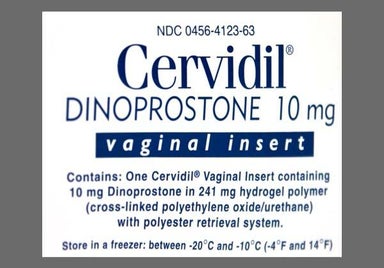
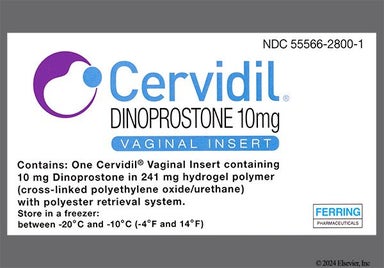
Cervidil (dinoprostone) images