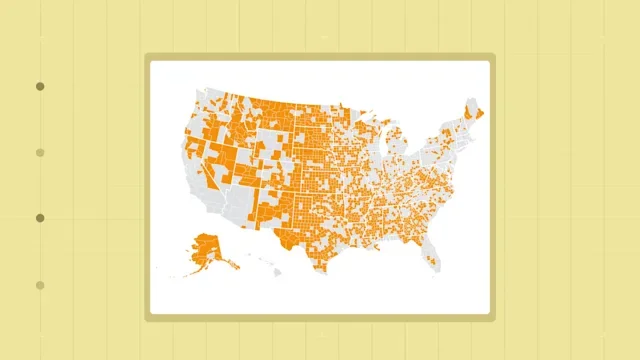
More than 80% of counties across the U.S. lack proper access to the services needed to maintain health, according to new analysis from GoodRx Research.
Access to healthcare can be defined as having an adequate supply of services to help people maintain or improve their health. These services span many dimensions of healthcare, including medications, primary care providers, hospitals, emergency services, and community health centers. Access is also affected by socioeconomic factors like affordability, internet access, and health literacy. In an ideal world, everyone would have equal access to necessary health services, and the means to gain access to these services. But this just isn’t the case.
The GoodRx Research team set out to identify areas that lack the proper infrastructure to ensure a healthy community, and understand just how socioeconomic factors play a role in people’s ability to take advantage of healthcare services.
We did this by identifying “healthcare deserts,” or areas across the U.S. where people lack adequate access to six key healthcare services: (1) pharmacies, (2) primary care providers, (3) hospitals, (4) hospital beds, (5) trauma centers, and (6) low-cost health centers. We then looked at how personal and financial barriers can make it even harder to access care in a healthcare desert and perpetuate health disparities.
In our full white paper, GoodRx Research dives into how healthcare infrastructure 一 or lack thereof 一 shapes access to healthcare. Through our research, we identified seven key findings:
1) More than 80% of counties across the U.S. lack adequate healthcare infrastructure in some shape or form. That means that over a third of the U.S. population lives in a county where there is less than adequate access to pharmacies, primary care providers, hospitals, trauma centers, and/or low-cost health centers.
2) Over 40% of counties are pharmacy deserts, where most people have to drive more than 15 minutes to reach nearby pharmacies.
3) Over 9% of counties are primary care provider deserts, where there aren’t enough healthcare professionals to provide primary care for most of the local population.
4) Over 20% of counties are hospital deserts, where most people have to drive more than 30 minutes to reach the closest hospital. On top of that, nearly 47% of counties have fewer than 2 hospital beds per 1,000 people.
5) Over 40% of counties are trauma center deserts, where most people have to drive over an hour to reach a hospital equipped to handle major traumatic injuries.
6) Over 45% of counties are low-cost health center deserts, where most people have to drive more than 20 minutes to reach a federally funded community health center.
7) Healthcare deserts are more likely to affect those who face additional barriers to access, such as lower income, limited internet access, and lack of insurance. Together, these barriers can further widen disparities in health outcomes.
Read our full white paper, “Mapping Healthcare Deserts: 80% of the Country Lacks Adequate Access to Healthcare” here.
*This is the author’s independent analysis of data extracted from the following source: National Council for Prescription Drug Programs, Inc. (NCPDP); January 2021 – December 2021, dataQ® Pharmacy Database v3.1.
References
Akhter, S. (2018). The new healthcare policy mandates a minimum of 2 beds per 1000. The Economic Times Health World.
Ambroggi, M., et al. (2015). Distance as a barrier to cancer diagnosis and treatment: Review of the literature. Oncologist.
American Trauma Society. (2021). Trauma center levels explained.
Amin, K., et al. (2020). How might internet connectivity affect health care access? Peterson-KFF Health System Tracker.
Becker, M. (2021). The digital divide is deepening vaccine frustrations. The Buffalo News.
Bosanac, B., et al. (1976). Geographic access to hospital care: A 30-minute travel time standard. Medical Care.
Boscoe, F., et al. (2012). A nationwide comparison of driving distance versus straight-line distance to hospitals. The Professional Geographer.
Branas, C., et al. (2005). Access to Trauma Centers in the United States. JAMA.
Brown, E. (2021). Residents of Vermont’s Essex County struggle to find health care. CBS WCAX Channel 3.
Centers for Disease Control and Prevention. (2021). Infant health.
Centers for Disease Control and Prevention. (2021). Infant mortality.
Crandall, M., et al. (2013). Trauma deserts: Distance from a trauma center, transport times, and mortality from gunshot wounds in Chicago. American Journal of Public Health.
Fitzpatrick, A., et al. (2004). Barriers to health care access among the elderly and who perceives them. American Journal of Public Health.
Foster, S. (2020). Survey: As coronavirus spreads, nearly 1 in 3 Americans admit to not seeking medical care due to cost. Bankrate.
Garfield, R., et al. (2019). The uninsured and the ACA: A primer - Key facts about health insurance and the uninsured amidst changes to the Affordable Care Act. Kaiser Family Foundation.
Gulliford, M., et al. (2002). What does 'access to health care' mean? Journal of Health Services Research & Policy.
Haefner, M., (2021). Why one of America's largest cities has a hospital desert. Becker’s Hospital Review.
Health Resources & Services Administration. (2021). Health Resources & Services Administration.
Health Resources & Services Administration. (2020). National Health Center program uniform data system (UDS) awardee data.
Health Resources & Services Administration Bureau of Health Workforce. (2021). Designated health professional shortage areas statistics.
Health Resources & Services Administration Bureau of Health Workforce. (2020). Scoring shortage designations.
Health Resources & Services Administration Bureau of Health Workforce. (2021). What is a health professional shortage area (HPSA)?
Health Resources & Services Administration Health Center Program. (2021). What is a health center?
Indian Health Service. (2021). Locations.
Kaiser Family Foundation. (2019). Health insurance coverage of the total population.
Lam, O., et al. (2018). How far Americans live from the closest hospital differs by community type. Pew Research Center.
Lowrey, N. (2020). Some COVID-19 patients flown out of state as S.D. hospital ICU capacity dwindles. Argus Leader.
Martinez, J., et al. (2003). Transitioning youths into care: linking identified HIV-infected youth at outreach sites in the community to hospital-based clinics and or community-based health centers. Journal of Adolescent Health.
Mississippi State Department of Health. (2021). Primary Care Office.
National Council for Prescription Drug Programs, Inc. (2021). dataQ® Pharmacy Database v3.1.
Office of the Assistant Secretary for Planning and Evaluation. (2021). 2021 poverty guidelines.
Organization for Economic Cooperation and Development. (2021). Hospital beds.
Peebles, A., et al. (2021). Delta forces hospitals across U.S. to ration scarce ICU beds. Bloomberg.
Probst, J., et al. (2007). Effects of residence and race on burden of travel for care: cross sectional analysis of the 2001 US National Household Travel Survey. BMC Health Services Research.
Ravaghi, H., et al. (2020). Models and methods for determining the optimal number of beds in hospitals and regions: a systematic scoping review. BMC Health Services Research.
Sampalis, JS., et al. (1993). Impact of on-site care, prehospital time, and level of in-hospital care on survival in severely injured patients. The Journal of Trauma.
Scrase, D., et al. (2021). Struggling to find a doctor? Santa Fe Reporter.
Starfield, B. (2005). Contribution of primary care to health systems and health.
Syed, S., et al. (2013). Traveling towards disease: Transportation barriers to health care access. Journal of Community Health.
The William and Anita Newman Library. (2020). US census population centroids.
United Health Foundation. (2020). America's health rankings 2020.
United States Census Bureau. (2020). American Community Survey 5-Year Data (2009-2019).
University Medical Center. (2020). University Medical Center.
U.S. Department of Agriculture Economic Research Service. (2021). Food access research atlas.
U.S. Department of Homeland Security. (2021). Homeland infrastructure foundation-level data (HIFLD).
Usufzy, P. (2016). Nevada’s only Level 1 trauma center sees ‘worst’ every day. AP News.
Winnegar, A. (2021). Difficulties of finding a primary care doctor. Santa Fe New Mexican.

Why trust our experts?